
Introduction
Digital marketing has become one of the most important parts of modern business. From small local businesses to global corporations, almost every organization today depends on digital platforms to reach customers, promote products, build relationships, and generate sales.
The development of digital marketing has completely changed the way businesses communicate with their audiences. In the past, companies mainly depended on newspapers, television, radio, magazines, billboards, brochures, and other traditional forms of advertising. These methods could reach large audiences, but businesses often had limited control over targeting, measurement, personalization, and customer interaction.
The rise of the internet introduced a completely different approach to marketing. Businesses could create websites, send emails, advertise on search engines, communicate through social media, publish online content, and interact directly with customers. As technology continued to develop, digital marketing also evolved rapidly.
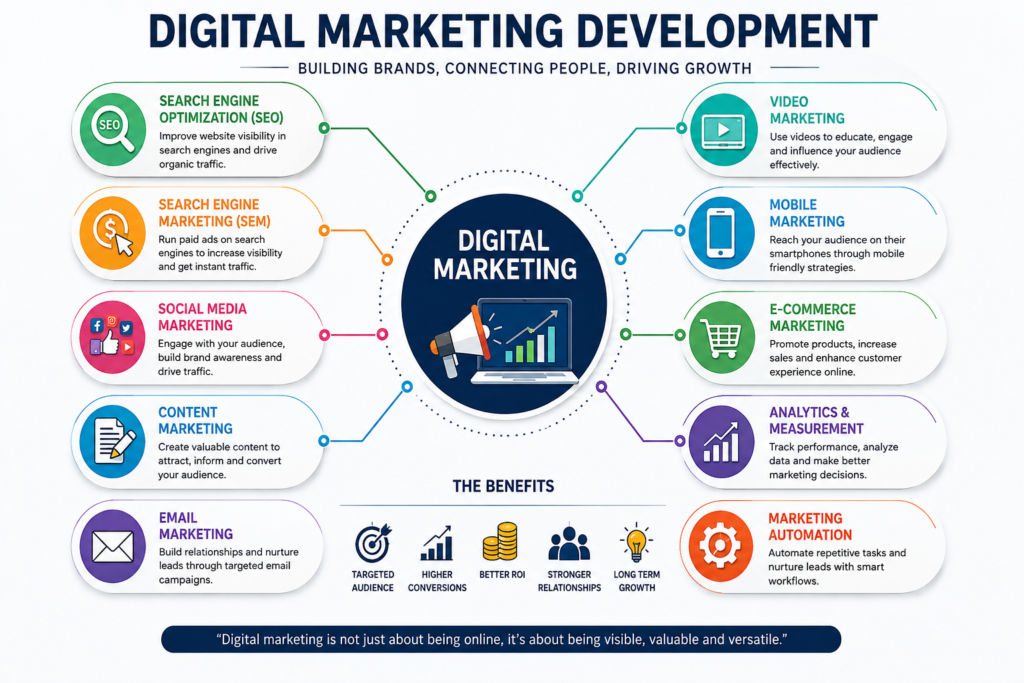
Today, digital marketing includes a wide range of activities such as Search Engine Optimization (SEO), Search Engine Marketing (SEM), social media marketing, content marketing, email marketing, influencer marketing, affiliate marketing, online advertising, video marketing, mobile marketing, and marketing automation.
The development of digital marketing is not simply a story about the growth of the internet. It is a story about how consumer behavior, technology, data, communication, and business strategies have changed together.
Understanding the development of digital marketing is important for students, entrepreneurs, marketers, business owners, and professionals because it helps explain where digital marketing came from, how it works today, and where it may go in the future.
What Is Digital Marketing?
Digital marketing refers to the promotion of products, services, brands, or businesses through digital channels and technologies.
These channels can include:
- Search engines
- Websites
- Social media platforms
- Mobile applications
- Online advertising platforms
- Video platforms
- E-commerce websites
- Online communities
- Digital content platforms
The primary objective of digital marketing is to connect businesses with potential customers through the digital environments they already use.
For example, a person searching Google for “best digital marketing institute in Mumbai” may discover an institute through an SEO-optimized website. Someone watching a video on YouTube may see an advertisement for a course. Another person may discover the same business through an Instagram post.
All these activities are examples of digital marketing.
One of the biggest advantages of digital marketing is measurability. Businesses can track website visits, clicks, impressions, leads, conversions, engagement, advertising performance, and many other metrics.
This data allows marketers to understand what is working and what needs improvement.
The Early Development of Digital Marketing
The roots of digital marketing can be traced back to the early development of computers and digital communication.
Before the internet became widely available, businesses were already experimenting with electronic databases and digital communication systems. However, marketing was still dominated by traditional media.
The development of the internet changed this situation.
As more people began using the World Wide Web, businesses recognized that websites could become powerful communication and marketing tools.
Early websites were relatively simple. Many businesses used them primarily to display information such as:
- Company details
- Product information
- Contact information
- Office locations
- Services
- Basic announcements
These websites were often static and had limited interaction.
Nevertheless, they represented an important change. Businesses were beginning to establish a digital presence.
The Rise of Search Engines
One of the most important developments in digital marketing was the emergence of search engines.
Search engines allowed internet users to find information by entering keywords and phrases. As search became an important part of online behavior, businesses realized that appearing in search results could generate valuable traffic.
This created the foundation for Search Engine Optimization, commonly known as SEO.
SEO involves improving a website so that search engines can understand its content and users can find it more easily through relevant searches.
Early SEO strategies were often relatively basic. Marketers focused heavily on keywords, website structure, metadata, and links.
Over time, search engines became much more sophisticated.
Modern search algorithms consider numerous factors related to relevance, content quality, usability, authority, and user experience.
The development of search engines therefore transformed marketing from simply broadcasting a message to helping customers discover businesses when they were actively looking for information.
The Development of Search Engine Advertising
Organic search was not the only opportunity created by search engines.
Search engine advertising allowed businesses to pay for visibility when users searched for specific keywords.
This became an important part of performance marketing.
Instead of paying only for general exposure, businesses could create advertisements targeted toward specific searches and audiences.
For example, a digital marketing institute could advertise for keywords related to:
- Digital marketing course
- Digital marketing institute
- SEO course
- Google Ads course
- Social media marketing course
Search advertising provided businesses with another major advantage: measurable results.
Advertisers could monitor impressions, clicks, conversions, cost per click, cost per lead, and other performance indicators.
This helped establish the concept of data-driven marketing.
The Growth of Websites and Online Businesses
As internet adoption increased, websites became more sophisticated.
Businesses started using websites not only to provide information but also to generate leads and sell products.
E-commerce played an especially important role in the development of digital marketing.
Online stores allowed consumers to research products, compare prices, read reviews, and complete purchases without visiting a physical store.
This changed consumer expectations.
Customers began expecting businesses to be available online.
A website became more than an optional marketing asset. For many businesses, it became an essential part of their identity.
Businesses started investing in:
- Website design
- Website development
- SEO
- Online catalogs
- E-commerce functionality
- Online payment systems
- Lead generation forms
- Customer support
- Content publishing
The development of websites therefore created a foundation for many modern digital marketing strategies.
The Email Marketing Revolution
Email marketing became another major milestone in digital marketing development.
Email provided businesses with a direct communication channel.
Instead of waiting for customers to see an advertisement, businesses could communicate directly with people who had provided their email addresses.
Companies began using email for:
- Promotional offers
- Newsletters
- Product announcements
- Event invitations
- Customer updates
- Educational content
- Lead nurturing
- Special discounts
Email marketing also introduced an important concept: permission-based communication.
Businesses could build databases of subscribers and communicate with audiences based on their interests.
As email technology improved, marketers gained the ability to segment audiences and personalize messages.
For example, an online store could send different emails to new customers, existing customers, inactive customers, and customers who had previously purchased particular products.
This represented a major step toward personalized digital marketing.
The Social Media Transformation
The development of social media created one of the biggest transformations in digital marketing.
Platforms such as Facebook, YouTube, Twitter, Instagram, LinkedIn, and other social networks changed the relationship between brands and customers.
Traditional advertising was primarily one-way communication.
A company created an advertisement, and customers consumed it.
Social media changed this model.
Customers could now:
- Comment
- Like
- Share
- Review
- Recommend
- Criticize
- Message businesses
- Create content about brands
This created two-way communication.
Businesses were no longer simply advertisers. They became participants in online communities.
Social media also made content an important part of marketing.
Businesses began creating:
- Images
- Videos
- Reels
- Stories
- Infographics
- Articles
- Polls
- Educational posts
- Live streams
The objective was not always to make an immediate sale. Businesses could also use social media to build awareness, trust, engagement, and long-term relationships.
The Development of Content Marketing
Content marketing became increasingly important as digital channels expanded.
Consumers were no longer dependent on advertisements for information. They could search for answers, watch tutorials, compare products, read reviews, and learn from experts before making purchasing decisions.
This created an opportunity for businesses to become sources of useful information.
Content marketing focuses on creating and distributing valuable, relevant, and useful content for a target audience.
Examples include:
- Blog articles
- Guides
- Tutorials
- Videos
- Podcasts
- Case studies
- E-books
- Infographics
- Webinars
- Social media content
For example, a digital marketing consultant could publish an article explaining how local businesses can improve their Google visibility.
The content can attract people searching for information, establish expertise, and potentially generate leads.
Content marketing therefore became closely connected with SEO, social media marketing, email marketing, and lead generation.
Mobile Marketing and the Smartphone Revolution
Another major stage in digital marketing development was the growth of smartphones.
The introduction and widespread adoption of smartphones changed how people accessed the internet.
Consumers could now browse websites, search Google, watch videos, use social media, shop online, and communicate with businesses from almost anywhere.
This forced marketers to think beyond desktop computers.
Websites needed to become mobile-friendly.
Advertisements needed to work on smaller screens.
Social media content became increasingly important.
Mobile applications became marketing channels.
Businesses also started using technologies such as push notifications, location-based marketing, mobile advertising, and mobile commerce.
The smartphone effectively turned the internet into an always-available environment.
This made digital marketing more immediate and personal.
The Development of Video Marketing
Video has become one of the most powerful forms of digital content.
Platforms such as YouTube helped establish online video as a major marketing channel, while social media platforms later accelerated short-form video consumption.
Businesses now use video to:
- Explain products
- Demonstrate services
- Educate audiences
- Share customer testimonials
- Introduce employees
- Build personal brands
- Answer common questions
- Promote offers
- Tell stories
Video marketing is especially powerful because it combines visuals, sound, storytelling, and human communication.
A business owner can use a short video to explain a service in a way that might require several paragraphs of written content.
This has contributed to the growth of personal branding as well.
Professionals can now build audiences around their knowledge, personality, expertise, and experiences.
Data-Driven Digital Marketing
One of the defining characteristics of modern digital marketing is the use of data.
Traditional marketing often made it difficult to determine exactly how many people saw an advertisement and how many eventually became customers.
Digital marketing provides much more measurable information.
Marketers can analyze:
- Website traffic
- Search queries
- Click-through rates
- Conversion rates
- Engagement
- Advertising costs
- Customer journeys
- Audience demographics
- Content performance
- Return on advertising spend
This information allows businesses to make more informed decisions.
Instead of relying entirely on assumptions, marketers can test campaigns and make changes based on performance.
For example, if an advertisement receives many impressions but very few clicks, the marketer may change the creative or headline.
If a landing page receives traffic but generates few leads, the marketer may improve the page design, offer, form, or messaging.
This continuous optimization is a central feature of modern digital marketing.
The Importance of Digital Marketing Development
The development of digital marketing has created opportunities for businesses of almost every size.
A small local business can create a website, establish a social media presence, optimize its Google visibility, publish useful content, and run targeted advertisements.
A startup can reach potential customers without building a large traditional advertising infrastructure.
An individual professional can build a personal brand and attract clients through content and social media.
Large companies can use advanced marketing technologies to manage audiences across multiple channels.
Digital marketing has therefore helped make marketing more accessible, measurable, flexible, and interactive.
Digital Marketing Development in India
India has experienced significant growth in digital marketing due to increasing internet usage, smartphone adoption, digital payments, social media usage, and e-commerce.
Businesses in cities such as Mumbai, Delhi, Bengaluru, Pune, Hyderabad, Chennai, and Ahmedabad increasingly use digital channels to connect with customers.
Local businesses have also benefited from digital marketing.
Restaurants, salons, gyms, educational institutes, consultants, real estate companies, clinics, retailers, agencies, and service providers can use digital platforms to attract customers in specific locations.
For example, a business targeting Mumbai can create location-focused content, optimize its website for local searches, maintain its business profile, collect reviews, and use targeted advertising.
This has contributed to the growing demand for digital marketing professionals in India.
From Traditional Marketing to Digital Marketing
The development of digital marketing does not mean traditional marketing has completely disappeared.
Instead, many businesses now combine traditional and digital methods.
A company might use:
- Television advertising for mass awareness
- Social media for engagement
- SEO for organic discovery
- Google Ads for immediate traffic
- Email marketing for customer retention
- Content marketing for education
- Offline events for relationship building
The modern marketing environment is therefore often integrated.
The biggest change is that customers now move between online and offline environments throughout the buying journey.
A customer might see a product in a store, search for reviews online, watch a YouTube video, visit the company’s website, compare competitors on social media, and finally make a purchase.
Digital marketing has become deeply connected with this modern customer journey.
Conclusion
The development of digital marketing has been a gradual but powerful transformation.
It began with the emergence of digital communication and websites, expanded through search engines and email, accelerated through social media and smartphones, and continues to evolve through data, automation, video, artificial intelligence, and advanced technologies.
Digital marketing has changed the way businesses reach customers and the way customers discover, evaluate, and purchase products and services.
However, the development of digital marketing is far from complete.
The next stage includes advanced SEO, social media algorithms, influencer marketing, automation, artificial intelligence, personalization, performance marketing, voice search, data analytics, and emerging technologies.
Introduction to Modern Digital Marketing
The development of digital marketing has moved far beyond simply having a website or posting advertisements online. Modern digital marketing is a complete ecosystem in which businesses use multiple digital channels to attract, engage, convert, and retain customers.
Today, a successful digital marketing strategy can combine search engines, social media, websites, content, email, paid advertising, video, analytics, automation, and artificial intelligence.
Each channel serves a different purpose, but they work together to create a complete customer journey.
For example, a potential customer may first discover a business through a Google search. They may then visit the company’s website, read a blog, follow the business on Instagram, watch a video, receive an email, and finally purchase a product.
This interconnected journey demonstrates how much digital marketing has developed.
1. Search Engine Optimization
Search Engine Optimization, commonly known as SEO, is one of the most important developments in digital marketing.
SEO focuses on improving a website’s visibility in unpaid search engine results.
The objective is to help search engines understand a website and make it easier for relevant users to discover it.
SEO includes several areas.
On-Page SEO
On-page SEO focuses on elements that exist on a website.
These can include:
- Page titles
- Meta descriptions
- Headings
- Keywords
- Content
- Internal links
- Image optimization
- URLs
- User experience
Modern SEO is no longer about repeatedly placing keywords on a page. Search engines have become much more sophisticated.
Content needs to satisfy user intent, provide useful information, demonstrate expertise, and offer a positive experience.
Technical SEO
Technical SEO focuses on the technical foundation of a website.
Important areas include:
- Website speed
- Mobile usability
- Crawlability
- Indexability
- Site architecture
- Structured data
- HTTPS
- Canonicalization
- XML sitemaps
Technical SEO has become increasingly important because search engines need to efficiently crawl and understand websites.
Off-Page SEO
Off-page SEO involves activities outside the website that can contribute to its authority and reputation.
Link building, digital PR, brand mentions, citations, and online reputation can play a role in developing website authority.
SEO continues to evolve as search engines become better at understanding natural language, context, entities, and user intent.
2. Search Engine Marketing
Search Engine Marketing, or SEM, represents another major development in digital marketing.
Businesses can use paid search advertising to appear prominently when potential customers search for relevant keywords.
Unlike SEO, which generally focuses on organic visibility, paid search allows businesses to purchase advertising placements.
A company can create campaigns targeting specific:
- Keywords
- Locations
- Devices
- Audiences
- Search behaviors
- Time periods
One of the major advantages of search advertising is its measurability.
Businesses can track clicks, leads, conversions, costs, and revenue.
This has contributed significantly to the growth of performance marketing.
3. Social Media Marketing
Social media marketing has transformed how businesses communicate with audiences.
Platforms have evolved from simple networking websites into powerful marketing ecosystems.
Businesses can now create organic content, run advertisements, collaborate with creators, communicate with customers, and build communities.
Social media marketing can support several objectives:
- Brand awareness
- Engagement
- Lead generation
- Website traffic
- Sales
- Customer service
- Personal branding
- Community building
The development of short-form video has made platforms particularly powerful for content discovery.
Businesses can now communicate their message through short videos, educational clips, product demonstrations, customer stories, and behind-the-scenes content.
Social media has also created a major opportunity for small businesses.
A local business with a limited marketing budget can create valuable content and potentially reach thousands of people.
4. Content Marketing
Content marketing has become a fundamental part of modern digital marketing.
Instead of constantly asking customers to purchase something, businesses can provide useful information.
A company selling fitness equipment, for example, might publish articles about workout routines, equipment selection, nutrition, and exercise tips.
The content can attract people who are interested in the subject before they are ready to purchase.
Content marketing helps businesses build authority and trust.
Common forms of content include:
- Blog posts
- Videos
- Podcasts
- Guides
- E-books
- Case studies
- Infographics
- Social media posts
- Webinars
- Newsletters
The development of content marketing has also changed the role of marketers.
Modern marketers often need to understand writing, design, SEO, video, audience research, analytics, and storytelling.
5. Email Marketing
Email marketing remains one of the most useful digital marketing channels.
Businesses can use email to communicate with customers throughout the buying journey.
For example, an online store can send:
- Welcome emails
- Product recommendations
- Promotional offers
- Abandoned-cart reminders
- Educational newsletters
- Customer feedback requests
- Loyalty offers
Email marketing has become more sophisticated through automation and segmentation.
Instead of sending one message to everyone, marketers can create different campaigns for different groups.
This makes communication more relevant and personalized.
6. Influencer Marketing
The growth of social media created another important development: influencer marketing.
Influencers are individuals who have developed an audience around a specific topic, lifestyle, profession, interest, or community.
Brands can collaborate with creators to introduce products and services to relevant audiences.
Influencer marketing can include:
- Sponsored posts
- Product reviews
- Video collaborations
- Tutorials
- Unboxing videos
- Brand partnerships
- Affiliate campaigns
The development of influencer marketing demonstrates how digital marketing has shifted from company-controlled communication toward creator-led communication.
Consumers often follow creators because they find their opinions, experiences, and personalities interesting.
For this reason, authenticity has become an important consideration in influencer campaigns.
7. Video Marketing
Video marketing has become one of the fastest-growing areas of digital communication.
Businesses use videos to explain complex topics, demonstrate products, answer questions, and tell stories.
Long-form videos can provide detailed education, while short-form videos can quickly capture attention.
Video content can be distributed across websites, social media platforms, video platforms, and advertising networks.
The development of affordable smartphones and video-editing tools has also reduced the barriers to video creation.
A small business no longer needs an expensive studio to produce useful marketing content.
A smartphone, good lighting, clear audio, and a strong idea can often be enough to begin.
8. Mobile Marketing
The growth of smartphones has made mobile marketing essential.
People increasingly use mobile devices for:
- Search
- Shopping
- Social media
- Banking
- Entertainment
- Communication
- Research
Businesses therefore need to ensure that their digital experiences work effectively on mobile devices.
Mobile marketing includes:
- Mobile-friendly websites
- Mobile advertising
- SMS marketing
- Push notifications
- Mobile applications
- Location-based marketing
The development of mobile marketing has made digital marketing more immediate.
Consumers can interact with brands from almost anywhere.
9. Online Advertising
Online advertising has developed significantly over the years.
Modern advertising platforms allow businesses to target audiences using different characteristics and signals.
Depending on the platform and campaign, businesses may target audiences based on factors such as:
- Location
- Interests
- Search behavior
- Demographics
- Website activity
- Previous interactions
Digital advertising also provides detailed reporting.
Marketers can analyze impressions, clicks, conversions, cost per acquisition, and other metrics.
This allows campaigns to be continuously optimized.
10. Local Digital Marketing
Local marketing has become particularly important for small and medium-sized businesses.
A customer looking for a restaurant, salon, gym, consultant, educational institute, or service provider often searches online before making a decision.
Local digital marketing helps businesses become visible to customers in specific geographic areas.
Important strategies can include:
- Local SEO
- Location-based website content
- Business listings
- Customer reviews
- Local social media content
- Location-focused advertising
- Local backlinks
- Community engagement
For example, a business targeting Mumbai may create content relevant to customers searching for services in areas such as Andheri, Bandra, Powai, Mahim, or other localities.
This demonstrates how digital marketing can become highly targeted.
11. Marketing Analytics
Data analytics has become one of the foundations of modern digital marketing.
Marketers need to understand not only how many people saw an advertisement but also what happened afterward.
Analytics can help answer questions such as:
- Where did website visitors come from?
- Which pages received the most traffic?
- Which campaigns generated leads?
- Which content performed best?
- Where are customers leaving the website?
- Which channels produce the highest return?
- How much does it cost to acquire a customer?
Analytics therefore supports better decision-making.
Instead of simply saying that a campaign “performed well,” marketers can examine specific data and determine why.
12. Conversion Rate Optimization
As digital marketing developed, businesses realized that generating traffic was only one part of the process.
A website can receive thousands of visitors but generate very few customers.
Conversion Rate Optimization, or CRO, focuses on improving the percentage of visitors who complete desired actions.
These actions may include:
- Filling out a form
- Calling a business
- Buying a product
- Booking an appointment
- Downloading a resource
- Signing up for a newsletter
CRO can involve testing headlines, buttons, layouts, forms, offers, images, and messaging.
This reflects the increasingly scientific nature of digital marketing.
13. Marketing Automation
Marketing automation has significantly changed how marketers manage campaigns.
Automation allows businesses to create predefined processes that perform actions based on customer behavior.
For example:
A visitor downloads an e-book.
The system sends a thank-you email.
After several days, another educational email is sent.
If the user clicks a product link, they may enter a different campaign.
This can save time and create consistent communication.
Automation is particularly useful for businesses managing large audiences.
14. Artificial Intelligence in Digital Marketing
Artificial intelligence is one of the most significant recent developments in digital marketing.
AI tools can assist marketers with:
- Content ideas
- Keyword research
- Data analysis
- Customer segmentation
- Chatbots
- Ad optimization
- Personalization
- Predictive analysis
- Content creation
- Customer support
AI can help marketers process large amounts of information faster.
However, successful marketing still requires human judgment.
A tool may generate content quickly, but marketers need to ensure that the content is accurate, useful, original, relevant, and aligned with the brand.
The development of AI is therefore changing the role of digital marketers rather than simply eliminating the need for them.
15. Personalization
Customers increasingly expect relevant communication.
Personalization allows businesses to customize messages according to customer characteristics or behavior.
For example, an e-commerce website may recommend products based on previous browsing or purchasing behavior.
An email campaign may use different messages for new customers and existing customers.
Personalization can improve relevance and customer experience.
The challenge is balancing personalization with responsible data use and customer privacy.
16. Omnichannel Marketing
Another important development is omnichannel marketing.
Customers do not always use one platform.
They may interact with a brand through Google, Instagram, email, WhatsApp, a website, an application, and a physical store.
Omnichannel marketing aims to create a connected experience across these channels.
For example, a customer might discover a product through Instagram, visit the website, add the product to a cart, receive an email reminder, and complete the purchase through the mobile website.
The goal is to make the journey consistent and convenient.
17. Customer Relationship Management
Digital marketing has also become closely connected with Customer Relationship Management, or CRM.
CRM systems allow businesses to organize customer information and interactions.
Businesses can use CRM data to understand:
- Leads
- Customers
- Purchases
- Communication history
- Sales stages
- Customer preferences
The combination of CRM and digital marketing allows businesses to create more organized customer journeys.
18. Personal Branding
Digital marketing development has created opportunities for individuals as well as businesses.
Professionals can build personal brands through:
- YouTube
- Blogs
- Podcasts
- Online communities
A personal brand can help professionals demonstrate expertise and attract clients, employers, partnerships, or business opportunities.
Digital marketing has therefore democratized visibility.
An individual with valuable knowledge can potentially build an audience without depending entirely on traditional media.
Conclusion
Modern digital marketing is a combination of many interconnected disciplines.
SEO helps people discover businesses.
Paid advertising creates immediate visibility.
Social media builds communities.
Content marketing provides value.
Email marketing develops relationships.
Analytics provides insight.
Automation improves efficiency.
AI creates new possibilities.
Personalization improves relevance.
Together, these developments have transformed digital marketing into a sophisticated and measurable business function.
However, the development of digital marketing is still continuing.
The next stage will be influenced by artificial intelligence, privacy, automation, immersive technology, changing search behavior, social commerce, voice technology, and new consumer expectations.
The Future of Digital Marketing
Digital marketing has changed dramatically over the last few decades, but its development is far from finished.
Technology continues to evolve, consumer behavior changes rapidly, and new platforms appear regularly.
The future of digital marketing will likely be shaped by artificial intelligence, automation, personalization, privacy, video, social commerce, immersive experiences, conversational marketing, and advanced data analysis.
Businesses that understand these changes will have greater opportunities to adapt and remain competitive.
1. Artificial Intelligence Will Become More Important
Artificial intelligence is already changing digital marketing, and its influence is likely to grow.
AI can process large amounts of data, identify patterns, automate repetitive tasks, and support decision-making.
Marketers can use AI for:
- Content ideation
- Audience analysis
- Campaign optimization
- Customer service
- Data interpretation
- Personalization
- Predictive marketing
- Ad optimization
- Chatbots
- Workflow automation
However, AI should be viewed as a tool rather than a complete replacement for human creativity and strategy.
Marketing requires understanding people.
Human marketers still need to understand emotions, cultural context, brand positioning, storytelling, customer needs, and business objectives.
The strongest marketing strategies will likely combine human creativity with machine intelligence.
2. AI-Powered Search
Search behavior is also changing.
For many years, users entered keywords into search engines and received a list of websites.
Modern search experiences increasingly provide direct answers, summaries, recommendations, and conversational interactions.
This means businesses may need to think beyond traditional keyword rankings.
They will need to create content that is:
- Helpful
- Accurate
- Clear
- Authoritative
- Structured
- Relevant
- Easy for users and systems to understand
SEO is therefore likely to continue evolving.
The fundamental goal remains the same: helping people find useful information.
However, the methods used to achieve that goal may change.
3. The Growth of Short-Form Video
Short-form video has become a major part of digital content consumption.
Short videos allow brands to communicate messages quickly.
Businesses can use short-form content for:
- Tips
- Tutorials
- Product demonstrations
- Educational content
- Behind-the-scenes videos
- Customer stories
- Industry updates
- Personal branding
The future of digital marketing will likely continue to emphasize video because video can combine information, entertainment, personality, and storytelling.
However, creating large quantities of content is not enough.
Quality, relevance, originality, and audience understanding remain important.
4. Social Commerce
Social media is increasingly connected with shopping.
Instead of discovering a product on social media and then searching for it elsewhere, customers can increasingly move from discovery to purchase within connected digital experiences.
Social commerce can reduce friction in the buying journey.
Businesses can use social platforms to:
- Display products
- Demonstrate products
- Answer questions
- Build trust
- Collect engagement
- Drive purchases
This creates a closer connection between social media marketing and e-commerce.
5. Conversational Marketing
Customers increasingly expect quick responses.
Conversational marketing uses chat, messaging, chatbots, and other communication tools to interact with potential customers.
For example, a visitor may ask:
“What are your course fees?”
“Do you provide online classes?”
“What services do you offer?”
A conversational system can provide immediate answers or direct the customer to the appropriate team.
This can improve customer experience and reduce response time.
6. Privacy and Responsible Data Use
As digital marketing becomes more data-driven, privacy becomes increasingly important.
Consumers want businesses to protect their personal information.
Marketers therefore need to understand responsible data collection, consent, security, transparency, and applicable regulations.
The future of digital marketing will not simply be about collecting as much data as possible.
It will be about using appropriate data responsibly to provide genuine value.
Trust will become an increasingly important competitive advantage.
7. First-Party Data
Changes in digital privacy have increased interest in first-party data.
First-party data is information that businesses collect directly through interactions with their own audiences.
Examples can include:
- Email subscribers
- Customer purchases
- Website interactions
- Account information
- Customer preferences
- Direct feedback
Building direct relationships with customers can help businesses become less dependent on external platforms.
This makes websites, email lists, communities, and CRM systems increasingly valuable.
8. Interactive Content
Digital marketing is also becoming more interactive.
Instead of simply reading or watching content, users can participate.
Examples include:
- Quizzes
- Polls
- Calculators
- Surveys
- Interactive infographics
- Assessments
- Product configurators
Interactive content can increase engagement because users actively participate in the experience.
9. Augmented and Virtual Reality
Immersive technologies may create new opportunities for digital marketing.
Augmented reality can allow customers to visualize products in their environment.
For example, a furniture business could allow customers to see how a product might look inside their home.
Virtual reality can create immersive experiences for industries such as:
- Real estate
- Travel
- Education
- Entertainment
- Automotive
- Retail
These technologies are still developing, but they demonstrate how digital marketing can move beyond screens toward more immersive experiences.
10. Voice Search
Voice technology has changed how some users interact with digital devices.
Instead of typing a query, users can ask questions verbally.
This creates new considerations for marketers.
Businesses may need to focus on conversational language, question-based content, local information, and clear answers.
Voice search is another example of how changes in technology can influence search behavior and SEO.
11. Community-Based Marketing
The internet has made it possible for brands to build communities around shared interests.
Communities can exist through:
- Social media groups
- Messaging platforms
- Forums
- Membership websites
- Online events
- Creator communities
Community marketing focuses on relationships rather than one-time transactions.
Strong communities can generate loyalty, recommendations, feedback, and long-term engagement.
12. Customer Experience Will Become More Important
Digital marketing is no longer only about attracting attention.
Businesses must also provide a good customer experience.
Imagine a company runs an excellent advertising campaign and receives thousands of visitors.
If the website is slow, confusing, difficult to navigate, or fails to provide accurate information, customers may leave.
This means marketing and customer experience are closely connected.
Important areas include:
- Website usability
- Mobile experience
- Page speed
- Customer service
- Communication
- Checkout experience
- After-sales support
The future of digital marketing will therefore involve the complete customer journey.
13. Performance Marketing
Performance marketing will continue to be important because businesses want measurable outcomes.
Instead of focusing only on impressions or awareness, companies increasingly want to understand:
- How many leads were generated?
- How many sales occurred?
- What was the acquisition cost?
- Which campaign generated revenue?
- Which audience produced the best results?
Performance marketing uses data and optimization to connect marketing activity with measurable business outcomes.
14. Digital Marketing for Small Businesses
Digital marketing has created significant opportunities for small businesses.
A small company does not necessarily need a massive advertising budget to establish an online presence.
It can start with:
- A professional website
- Local SEO
- Social media profiles
- Helpful content
- Customer reviews
- Email marketing
- Targeted advertising
Small businesses can compete by focusing on specific audiences and locations.
For example, instead of attempting to rank nationally for a broad keyword, a local business can target customers searching for a service in a particular city or neighborhood.
This makes digital marketing particularly valuable for local businesses.
15. The Role of Digital Marketing Professionals
The development of digital marketing has created many career opportunities.
Professionals can specialize in areas such as:
- SEO
- Google Ads
- Social media marketing
- Content marketing
- Email marketing
- Performance marketing
- Analytics
- Affiliate marketing
- E-commerce marketing
- Influencer marketing
- Marketing automation
- Digital strategy
Some professionals work in agencies.
Others work in-house for companies.
Many also work as freelancers or consultants.
The field therefore provides multiple career paths.
16. Skills Required for Digital Marketing
Digital marketing is a constantly changing field.
Professionals need both technical and creative skills.
Important skills can include:
Communication
Marketers need to communicate clearly with customers, clients, colleagues, and audiences.
Content Creation
The ability to create useful written, visual, and video content is increasingly valuable.
SEO
Understanding how search works helps marketers attract organic traffic.
Advertising
Paid advertising skills can help businesses generate targeted traffic and leads.
Analytics
Marketers need to understand data and performance metrics.
Creativity
Creative thinking helps brands stand out in crowded digital environments.
Adaptability
Digital platforms and technologies change quickly.
Successful marketers need to learn continuously.
17. Digital Marketing Education
As demand for digital marketing professionals has increased, training institutes and online learning platforms have also expanded.
Students can learn digital marketing through:
- Classroom courses
- Online courses
- Workshops
- Certifications
- Internships
- Practical projects
- Self-learning
Practical experience is especially important.
Digital marketing is not a field that can be mastered entirely through theory.
Students should practice creating campaigns, analyzing websites, developing content, understanding SEO, running advertising experiments, and measuring results.
18. The Importance of Continuous Learning
One of the defining characteristics of digital marketing is change.
Search algorithms change.
Advertising platforms introduce new features.
Social media trends evolve.
Consumer behavior changes.
New AI tools appear.
New regulations may affect data usage.
For this reason, digital marketers need to continuously update their knowledge.
A professional who learned digital marketing several years ago cannot assume that every strategy will work exactly the same way today.
Continuous learning is therefore part of being a successful digital marketer.
19. Challenges in Digital Marketing
Although digital marketing offers many opportunities, it also has challenges.
Increasing Competition
More businesses are investing in digital marketing, making online visibility increasingly competitive.
Algorithm Changes
Search engines and social platforms frequently change how content and advertisements are distributed.
Content Saturation
The internet contains an enormous amount of content.
Businesses need to create genuinely useful and differentiated material.
Privacy Concerns
Marketers must balance personalization with responsible data practices.
Platform Dependency
Businesses that depend heavily on one social media platform may be affected by changes to its algorithm or policies.
Measuring Real Business Impact
Traffic and engagement are useful, but businesses ultimately need to connect marketing activity with meaningful outcomes.
20. The Future Digital Marketer
The future digital marketer will likely need to be more than a specialist in one platform.
They will need to understand the broader customer journey.
A modern marketer may need knowledge of:
- SEO
- Content
- Paid advertising
- Social media
- Analytics
- AI
- Automation
- Branding
- Customer psychology
The ability to connect different marketing activities will become increasingly valuable.
Digital Marketing Development: From Advertising to Customer Experience
One of the most important lessons from the development of digital marketing is that marketing has moved from simple advertising toward customer experience.
Traditional advertising primarily focused on communicating a message.
Modern digital marketing focuses on the complete relationship between a customer and a business.
The process can look like this:
Discovery → Awareness → Research → Engagement → Conversion → Retention → Advocacy
Digital channels can support every stage.
SEO can help with discovery.
Social media can create awareness.
Content can support research.
Email can encourage engagement.
Advertising can generate conversions.
CRM and customer service can support retention.
Satisfied customers can eventually become advocates.
This complete journey demonstrates the maturity of digital marketing.
How Businesses Can Adapt to Digital Marketing Development
Businesses that want to remain competitive should treat digital marketing as an ongoing process rather than a one-time activity.
A practical approach can include the following steps.
Step 1: Understand the Target Audience
Businesses should identify who they want to reach.
Important questions include:
- Who are the customers?
- What problems do they have?
- What are they searching for?
- Which platforms do they use?
- What influences their purchasing decisions?
Step 2: Build a Strong Digital Foundation
A professional website, clear brand identity, and reliable contact information provide a foundation for digital marketing.
Step 3: Develop Valuable Content
Businesses should create content that answers customer questions and demonstrates expertise.
Step 4: Improve Search Visibility
SEO can help businesses attract relevant organic traffic.
Step 5: Use Paid Advertising Strategically
Paid campaigns can generate targeted traffic and leads when properly planned and optimized.
Step 6: Build Social Media Presence
Businesses should choose platforms that are relevant to their audience rather than trying to be everywhere.
Step 7: Measure Results
Analytics should be used to determine what is working.
Step 8: Improve Continuously
Digital marketing should follow a cycle of:
Test → Measure → Learn → Improve → Repeat
This mindset helps businesses adapt to change.
Conclusion
The development of digital marketing is one of the most significant changes in modern business communication.
From the early days of websites and email to today’s world of social media, search engines, mobile devices, video, automation, analytics, and artificial intelligence, digital marketing has continuously evolved.
The biggest change is not simply technological.
Consumer behavior has changed as well.
People now search for information online, compare products, read reviews, watch videos, communicate with brands, purchase through digital platforms, and share their experiences with others.
Businesses therefore need to meet customers where they are.
Modern digital marketing provides businesses with the ability to reach specific audiences, measure performance, personalize communication, build relationships, and improve campaigns continuously.
At the same time, digital marketing requires adaptability.
Strategies that work today may need to change tomorrow.
New technologies will continue to emerge, search behavior will continue to evolve, and customers will continue to develop new expectations.
The future of digital marketing will likely be shaped by artificial intelligence, automation, personalization, privacy, immersive technologies, social commerce, video, conversational experiences, and data-driven decision-making.
However, despite all these technological developments, one principle will remain important: successful marketing starts with understanding the customer.
Technology can help businesses reach people faster, analyze information more effectively, and automate communication. But meaningful marketing still depends on providing value, solving problems, building trust, and creating positive customer experiences.
For students and aspiring professionals, the development of digital marketing represents a major career opportunity. For entrepreneurs and business owners, it represents a powerful way to reach customers and grow their businesses.
Digital marketing is not a finished concept. It is an evolving ecosystem.
As technology continues to develop, digital marketing will continue to transform with it.
Businesses and professionals who learn, experiment, measure, and adapt will be better prepared for the future.
Final Takeaway
The journey of digital marketing can be summarized as:
Websites → Search Engines → Email → SEO → Online Advertising → Social Media → Mobile → Video → Analytics → Automation → AI → Personalized and Connected Customer Experiences
This evolution shows that digital marketing has moved from simply promoting products online to creating complete digital relationships with customers.
The future belongs to businesses that can combine technology with creativity, data with human understanding, and automation with authentic communication.
Digital marketing development will continue, and the businesses that embrace this development strategically will have greater opportunities to build visibility, trust, customer loyalty, and sustainable growth in the digital economy.