
Search engine optimization is one of the most important digital marketing strategies for businesses that want to increase their online visibility. While many people associate SEO with keywords, website content, and technical improvements, successful SEO involves much more than optimizing the pages of a website.
One of the major components of SEO is Off-Page SEO.
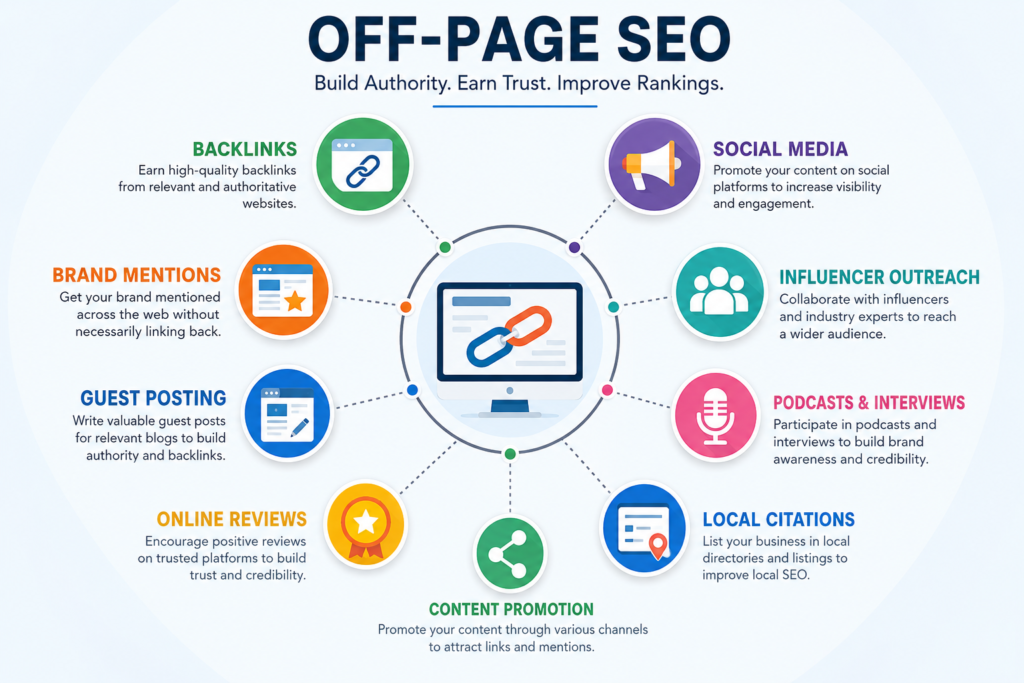
Off-Page SEO refers to all the activities performed outside your website to improve its authority, reputation, credibility, and visibility in search engine results. These activities help search engines understand how trustworthy and valuable your website is compared with competing websites.
In simple words, On-Page SEO focuses on improving your website, while Off-Page SEO focuses on improving how your website is perceived across the internet.
For example, when another reputable website links to your website, it can act as a recommendation or vote of confidence. When people mention your brand on social media, review platforms, business directories, forums, or other websites, these activities can contribute to your overall online presence.
However, modern Off-Page SEO is not simply about collecting as many backlinks as possible. Search engines have become significantly better at identifying unnatural, manipulative, and low-quality link-building practices. Therefore, businesses should focus on building genuine authority, earning relevant backlinks, creating valuable relationships, and establishing a strong digital reputation.
This comprehensive guide explains what Off-Page SEO is, why it matters, how it works, the most important Off-Page SEO techniques, common mistakes, and how businesses can develop an effective strategy.
What Is Off-Page SEO?
Off-Page SEO is the process of improving a website’s search engine visibility and authority through activities that take place outside the website itself.
The primary goal is to demonstrate to search engines that a website is trustworthy, authoritative, relevant, and valuable to users.
Some common Off-Page SEO activities include:
- Link building
- Guest posting
- Digital PR
- Brand mentions
- Local citations
- Business directory submissions
- Social media marketing
- Influencer outreach
- Online reputation management
- Forum participation
- Review generation
- Content promotion
- Competitor backlink analysis
- Relationship building
- Community engagement
Among these activities, backlinks remain one of the most widely discussed aspects of Off-Page SEO. However, Off-Page SEO is broader than backlinks alone.
Imagine you have launched a new restaurant. You may have an attractive website with excellent food photographs, a well-written menu, and optimized pages. But if nobody knows about your restaurant, attracting customers can still be difficult.
Now imagine that respected food bloggers, local publications, customers, business directories, and social media creators start mentioning your restaurant.
Your reputation begins to grow.
The same principle applies to websites.
Your website may have excellent content, but external signals can help establish credibility and authority.
Why Is Off-Page SEO Important?
Off-Page SEO is important because search engines need multiple signals to determine which websites deserve to rank prominently.
A website can have excellent content and still struggle to compete if it has little authority or visibility compared with established competitors.
Off-Page SEO can help businesses:
1. Build Website Authority
Authority is an important concept in SEO. When reputable websites reference or recommend your content, it can strengthen the overall authority of your website.
High-quality backlinks from relevant websites can be especially valuable because they provide external signals of credibility.
2. Improve Search Visibility
A strong Off-Page SEO strategy can support higher visibility for relevant keywords.
When your website develops authority and earns quality links, search engines may become more confident about ranking your pages for relevant searches.
3. Increase Referral Traffic
Not every backlink needs to be viewed only as an SEO signal.
A link from a popular website can generate direct referral traffic.
For example, suppose a well-known industry publication publishes an article and links to your website. Readers interested in the topic may click the link and visit your website.
This can bring highly relevant visitors without relying exclusively on search engines.
4. Increase Brand Awareness
Off-Page SEO can also increase the number of places where people encounter your brand.
Your business may appear on:
- Industry websites
- News publications
- Social media platforms
- Business directories
- Review websites
- Blogs
- Podcasts
- Forums
- Local websites
- Professional communities
The more relevant places your brand appears, the easier it can become for potential customers to recognize your business.
5. Establish Trust
Online trust is essential for almost every business.
When your brand is consistently mentioned by legitimate websites and customers, it can create stronger credibility.
People are more likely to trust a business that has a genuine online presence than one that appears to exist only on its own website.
Off-Page SEO vs On-Page SEO
Understanding the difference between On-Page SEO and Off-Page SEO is essential.
On-Page SEO
On-Page SEO involves optimizing elements within your website.
Examples include:
- Page titles
- Meta descriptions
- Headings
- Content
- Keywords
- Internal linking
- Image optimization
- URL structure
- User experience
- Content organization
- Search intent optimization
The goal is to make your website useful, understandable, and relevant to search engines and users.
Off-Page SEO
Off-Page SEO focuses on activities outside your website.
Examples include:
- Backlinks
- Brand mentions
- Guest contributions
- Digital PR
- Social media promotion
- Business citations
- Reviews
- Influencer marketing
- Community participation
- Content outreach
The goal is to increase your website’s reputation, authority, visibility, and relationships across the wider web.
Why Both Are Important
A successful SEO campaign usually requires both.
Think of SEO as building a business.
On-Page SEO is your shop.
You need an organized, attractive, useful, and trustworthy shop.
Off-Page SEO is your reputation.
Even if your shop is excellent, recommendations, publicity, reviews, relationships, and word-of-mouth can help more people discover it.
That is why businesses should not focus exclusively on one side of SEO.
What Are Backlinks in Off-Page SEO?
A backlink is a link from one website to another website.
For example, if Website A publishes an article and includes a link to Website B, Website B has received a backlink from Website A.
Backlinks have historically played a significant role in SEO because they can indicate that other websites consider a page useful or valuable.
However, all backlinks are not equal.
A backlink from a relevant and reputable website may be considerably more valuable than a large number of links from unrelated or low-quality websites.
This is why modern SEO should focus on quality, relevance, context, and natural acquisition rather than simply counting links.
Types of Backlinks
There are several ways to categorize backlinks.
1. Editorial Backlinks
Editorial backlinks are links naturally included within useful content.
For example, a digital marketing publication may write an article about SEO and reference a research study or useful resource from another website.
These links can be valuable because they are placed within relevant editorial content.
2. Guest Post Backlinks
Guest posting involves creating content for another relevant website.
Depending on the publication’s policies, the author may receive an attribution link to their website.
Guest posting should focus primarily on providing useful content to the publication’s audience rather than manipulating search rankings.
3. Business Directory Links
Business directories can provide backlinks and citations.
Examples include:
- Local business directories
- Industry directories
- Professional associations
- Local chambers
- Relevant niche directories
The directory should be legitimate and relevant rather than created solely for SEO purposes.
4. Social Media Links
Links can also be shared through social media platforms.
Social media activity can help distribute content, increase visibility, and attract visitors who may eventually reference the content elsewhere.
Social signals should not be treated as a simple substitute for authoritative backlinks. Instead, social media is better viewed as part of a broader visibility and content promotion strategy.
5. Resource Page Links
Some websites maintain resource pages containing useful tools, guides, studies, or references.
If your content genuinely provides value to the audience, you may be able to earn inclusion through appropriate outreach.
Quality vs Quantity in Link Building
One of the biggest misunderstandings about Off-Page SEO is the idea that more backlinks automatically mean better rankings.
This is not a reliable strategy.
Imagine two websites.
Website A has 1,000 backlinks from unrelated, low-quality websites.
Website B has 100 backlinks from relevant, trustworthy websites.
Website B may have a much stronger backlink profile despite having fewer links.
The quality of links matters.
Important considerations include:
Relevance
A link from a website related to your industry can make more contextual sense than a link from an unrelated website.
Authority
Links from established, trustworthy websites can be more valuable than links from unknown or low-quality domains.
Context
A link naturally included within relevant content is generally more meaningful than an unrelated link placed on a random page.
Editorial Value
Links that are genuinely earned through useful content, research, expertise, or relationships are generally preferable to manipulative link schemes.
Important Off-Page SEO Techniques
There are many Off-Page SEO techniques businesses can use to improve their online presence.
Let’s explore some of the most important ones.
1. Link Building
Link building is one of the most recognizable Off-Page SEO techniques.
The objective is to earn relevant, high-quality backlinks from other websites.
Instead of asking, “How can I get 1,000 backlinks?” businesses should ask:
“How can I create something valuable enough that other websites want to reference it?”
Potential link-worthy assets include:
- Original research
- Industry statistics
- Comprehensive guides
- Free tools
- Templates
- Case studies
- Surveys
- Infographics
- Expert interviews
- Useful calculators
- Original data
- Educational resources
When content provides unique value, it has a better chance of attracting natural references.
2. Guest Blogging
Guest blogging involves publishing useful articles on other websites.
A good guest blogging strategy begins with identifying websites that:
- Are relevant to your industry
- Have a genuine audience
- Publish quality content
- Maintain editorial standards
- Accept useful contributions
The objective should not be to publish the same article on dozens of websites.
Instead, create original content tailored to each audience.
For example, a digital marketer could contribute articles about:
- Local SEO
- SEO strategies
- Google Ads
- Social media marketing
- Content marketing
- Small business marketing
- Website optimization
Guest blogging can help with brand exposure, relationship building, referral traffic, and potentially backlinks when those links are appropriate and editorially justified.
3. Digital PR
Digital PR combines public relations with online marketing.
The goal is to generate online visibility through news coverage, expert commentary, publications, interviews, podcasts, and other digital channels.
For example, a business could:
- Publish original industry research
- Share expert insights
- Respond to industry trends
- Participate in interviews
- Offer expert commentary
- Release useful data
- Collaborate with publications
- Participate in podcasts
Digital PR can be powerful because successful campaigns may result in mentions from multiple authoritative websites.
Instead of directly requesting hundreds of backlinks, you create something newsworthy or valuable enough to attract attention.
4. Brand Mentions
A brand mention occurs when another website, publication, social media account, or online community talks about your business.
A brand mention does not always include a hyperlink.
Even when there is no link, brand visibility can be valuable from a marketing perspective.
Businesses should monitor where their brand appears online.
If someone mentions your company positively, you can potentially build a relationship with that publisher.
If an unlinked mention is relevant and the publisher accepts updates, you may also consider politely requesting a link.
However, outreach should always be natural and respectful.
5. Local SEO Citations
For local businesses, citations can be an important part of Off-Page SEO.
A citation generally refers to an online mention of a business’s details, such as:
- Business name
- Address
- Phone number
- Website
These listings can appear on:
- Business directories
- Local websites
- Industry directories
- Maps platforms
- Review websites
- Local organizations
Consistency is important.
If your business name, address, or phone number differs significantly across important platforms, it can create confusion.
Businesses should therefore maintain accurate and consistent information wherever they have legitimate listings.
6. Online Reviews
Reviews are extremely important for local businesses and service providers.
Customers often research a business before making a purchase decision.
Positive reviews can help build:
- Trust
- Credibility
- Social proof
- Customer confidence
- Local visibility
Businesses should encourage genuine customers to leave honest reviews.
The key word is genuine.
Buying fake reviews or creating misleading testimonials can damage trust and may violate platform policies.
A better approach is to provide an excellent customer experience and make it easy for satisfied customers to share their honest feedback.
7. Social Media Marketing
Social media is not simply about collecting followers.
It can also be used to distribute content, strengthen brand awareness, communicate with customers, and create relationships.
Businesses can promote:
- Blog posts
- Videos
- Case studies
- Guides
- Research
- Infographics
- Product updates
- Customer stories
Suppose you publish a detailed article about local SEO.
Instead of publishing it once and forgetting about it, you could create:
- A LinkedIn post
- An Instagram carousel
- A short video
- A Facebook post
- A YouTube Short
- A newsletter segment
This increases the number of opportunities for people to discover your content.
Some of those people may eventually reference your article, share it, or link to it.
8. Influencer Outreach
Influencer marketing can also support Off-Page SEO indirectly.
Influencers, creators, industry experts, and niche publishers may introduce your brand to new audiences.
The best partnerships are based on relevance.
For example, a fitness brand should ideally collaborate with creators who have an audience interested in health and fitness rather than selecting a creator solely because they have a large follower count.
The same principle applies to SEO.
Relevance is often more valuable than raw numbers.
9. Forum and Community Participation
Online communities can help businesses establish expertise.
Platforms and communities related to your industry may provide opportunities to answer questions and participate in discussions.
However, businesses should avoid spamming links.
Instead:
- Find relevant discussions.
- Understand the question.
- Provide a useful answer.
- Add a link only when it genuinely improves the response and community rules allow it.
The goal is to become a helpful participant rather than a promotional account.
10. Competitor Backlink Analysis
Competitor analysis can reveal useful opportunities.
Suppose your competitors are ranking for important keywords.
You can research:
- Which websites link to them
- Which publications mention them
- Which directories list them
- Which topics attract links
- Which content formats perform well
- Which digital PR opportunities they use
This does not mean copying competitors.
Instead, competitor research can help identify gaps and opportunities.
For example, if several competitors have earned links from an industry publication, you might investigate whether you can provide a stronger resource or pitch a genuinely useful contribution.
Why Natural Link Building Matters
Search engines have become increasingly sophisticated.
Manipulative link-building practices can create risks.
Businesses should therefore prioritize:
- Useful content
- Genuine relationships
- Relevant websites
- Editorial value
- Natural mentions
- Real audiences
- Sustainable strategies
A sustainable Off-Page SEO campaign may take time.
You may not see hundreds of backlinks within a few days.
But the goal is to build an online presence that becomes stronger over time.
What Makes a Backlink Valuable?
A valuable backlink usually has several positive characteristics.
1. It Comes From a Relevant Website
Relevance matters because the link should make sense in context.
2. It Is Contextually Appropriate
A link surrounded by useful information is generally more meaningful than one placed randomly.
3. The Website Has a Genuine Audience
A website with real readers can provide both SEO value and referral traffic.
4. The Link Is Editorially Justified
A link that naturally supports a statement or resource is preferable to an artificial link.
5. The Website Is Trustworthy
You should consider the overall quality and reputation of the linking website.
Common Off-Page SEO Mistakes
Businesses often make mistakes when implementing Off-Page SEO.
Understanding these mistakes can help you avoid unnecessary risks.
Buying Low-Quality Backlinks
Buying large quantities of low-quality links may appear attractive because it produces quick numbers.
However, quantity without quality can create a poor backlink profile.
Using Irrelevant Websites
A website about cooking linking to an unrelated industrial company may provide little contextual value.
Relevance should be considered when evaluating link opportunities.
Excessive Exact-Match Anchor Text
Anchor text refers to the clickable text used for a link.
Using the exact same keyword-rich anchor text repeatedly can appear unnatural.
A natural backlink profile usually contains varied anchor text, including:
- Brand names
- URLs
- Natural phrases
- Partial keyword phrases
- Generic terms
Spammy Directory Submissions
Submitting a website to hundreds of poor-quality directories is not an effective long-term strategy.
Focus on legitimate and relevant directories instead.
Automated Link Building
Automated software that creates large numbers of links can produce low-quality results and potentially create SEO problems.
Quality should always come before volume.
Off-Page SEO for Small Businesses
Small businesses can benefit significantly from Off-Page SEO.
A local business does not necessarily need thousands of backlinks to establish a strong online presence.
Instead, it can focus on highly relevant opportunities.
For example, a Mumbai-based business might consider:
- Local business directories
- Industry associations
- Mumbai business publications
- Local community websites
- Relevant bloggers
- Local partnerships
- Customer reviews
- Local PR
- Business profiles
- Social media communities
Local relevance can be extremely valuable.
Suppose a small bakery receives a mention from a respected local food publication.
That single mention may provide:
- Brand awareness
- Referral traffic
- Customer trust
- Potential SEO value
- Local visibility
This demonstrates why Off-Page SEO should not be treated purely as a backlink-counting exercise.
Off-Page SEO and Local SEO
Off-Page SEO and Local SEO often overlap.
For local businesses, external signals can help establish prominence and credibility.
Important activities may include:
- Maintaining business listings
- Building local citations
- Generating genuine reviews
- Earning local media coverage
- Building relationships with local organizations
- Participating in local events
- Getting mentioned by relevant local websites
- Creating locally relevant content
For example, a digital marketing consultant targeting customers in Mumbai could create resources about:
“Digital Marketing Strategies for Small Businesses in Mumbai.”
That content could potentially attract attention from local business communities, entrepreneurs, publications, and marketing-related websites.
This creates opportunities for both visibility and authority.
The Role of Content in Off-Page SEO
Content is at the center of many successful Off-Page SEO campaigns.
Why?
Because people generally link to and share useful things.
If your website contains generic content that provides little unique value, it may be difficult to earn attention.
But valuable content can create opportunities.
Examples include:
Original Research
Publish unique data or research that other websites can reference.
Comprehensive Guides
Create detailed resources that answer a topic better than competing pages.
Case Studies
Show real examples of strategies, challenges, and results.
Expert Interviews
Interview professionals and publish useful insights.
Free Tools
Develop calculators, templates, checklists, or tools that solve real problems.
Statistics Pages
Create useful collections of industry statistics, preferably with transparent sources and appropriate attribution.
Off-Page SEO Strategy: Where to Start
If you are new to Off-Page SEO, do not attempt everything simultaneously.
Start with a structured process.
Step 1: Analyze Your Current Backlink Profile
Identify:
- Existing backlinks
- Linking domains
- Relevant links
- Potentially suspicious links
- Brand mentions
- Competitor backlink sources
Step 2: Analyze Competitors
Find out:
- Who links to competitors?
- Which publications mention them?
- What content earns links?
- Which directories are relevant?
- What PR opportunities exist?
Step 3: Create Link-Worthy Content
Develop resources that provide genuine value.
Step 4: Build Relationships
Connect with:
- Bloggers
- Journalists
- Industry experts
- Local organizations
- Business owners
- Publishers
- Influencers
Step 5: Promote Your Content
Use:
- Social media
- Email outreach
- Communities
- PR
- Industry networks
Step 6: Monitor Results
Track:
- Referring domains
- Backlinks
- Referral traffic
- Brand mentions
- Search visibility
- Keyword performance
- Leads and conversions
Off-Page SEO is an ongoing process, not a one-time task.
Conclusion
Off-Page SEO is an essential part of a successful search engine optimization strategy.
It focuses on everything that happens beyond your website to build credibility, authority, visibility, and trust.
While backlinks remain an important component, effective Off-Page SEO goes far beyond link building.
It includes digital PR, brand mentions, local citations, reviews, social media promotion, influencer relationships, community participation, content promotion, and genuine relationship building.
The most successful approach is not to chase thousands of backlinks.
Instead, focus on creating useful resources, building relationships, earning mentions, and becoming a trusted source within your industry.
In Part 1, we covered the fundamentals of Off-Page SEO, why it matters, backlinks, brand mentions, local citations, reviews, social media, digital PR, and common mistakes.
In this second part, we will go deeper into the practical side of Off-Page SEO.
A successful Off-Page SEO campaign requires more than creating a few backlinks. Businesses need a structured strategy that combines content promotion, relationship building, digital PR, local visibility, competitor research, brand authority, and high-quality link acquisition.
The ultimate objective is to create a website that search engines and users recognize as useful, trustworthy, relevant, and authoritative.
Advanced Off-Page SEO Techniques
Off-Page SEO has evolved significantly over the years.
In the early days of SEO, marketers often focused heavily on acquiring large quantities of backlinks. Today, successful SEO requires a much more sophisticated approach.
Some of the most effective advanced techniques include:
- Digital PR
- Broken link building
- Resource page outreach
- Skyscraper content
- Guest contributions
- Unlinked brand mention outreach
- Expert roundups
- Podcast appearances
- Online interviews
- Community participation
- Local partnerships
- Influencer collaborations
- Data-driven content
- Competitor backlink analysis
- Content-led link building
Let’s examine these strategies in detail.
1. Digital PR for Off-Page SEO
Digital PR is one of the most powerful ways to build online authority.
Traditional public relations focuses on newspapers, magazines, television, radio, and other media.
Digital PR focuses heavily on online publications, websites, blogs, podcasts, social platforms, industry publications, and digital news channels.
A successful Digital PR campaign can help your business earn:
- Brand mentions
- Editorial backlinks
- Referral traffic
- Media exposure
- Industry credibility
- Brand awareness
Instead of directly asking websites to link to you, Digital PR focuses on creating something that journalists and publishers actually want to discuss.
Examples of Digital PR Content
A business could publish:
- Original industry research
- Consumer surveys
- Market reports
- Expert opinions
- Industry predictions
- Case studies
- Unique statistics
- Trend reports
- Customer behavior research
For example, a digital marketing agency could conduct a survey of small businesses about their marketing challenges.
The findings could become a report titled:
“Digital Marketing Trends and Challenges for Small Businesses in 2026.”
Industry publications may reference the research when writing their own articles.
This can generate natural mentions and potentially valuable backlinks.
2. Broken Link Building
Broken link building is an established Off-Page SEO technique.
The basic process involves finding broken links on relevant websites and suggesting your useful resource as a replacement.
For example, suppose a marketing website has an article about SEO tools.
Within the article, there is a link that no longer works.
You have a relevant and high-quality resource that provides the information the broken link was originally pointing toward.
You can contact the website owner and politely inform them about the broken link.
Then you can suggest your resource if it genuinely fits.
Basic Process
- Find relevant websites.
- Identify broken external links.
- Understand what the original resource was about.
- Create or identify a useful replacement.
- Contact the website owner.
- Explain the issue clearly.
- Suggest your resource naturally.
The key is relevance.
You should not recommend your website simply because a broken link exists.
Your resource should genuinely improve the page.
3. Resource Page Link Building
Many websites publish resource pages containing useful links for their readers.
Examples include:
- SEO resources
- Marketing tools
- Educational resources
- Industry guides
- Business tools
- Startup resources
- Local business resources
If you have created something genuinely useful, you can contact the website owner and suggest it.
For example, suppose you have created a detailed guide called:
“The Complete Local SEO Guide for Small Businesses.”
A marketing website maintaining a resources page about local SEO might find the guide useful.
The outreach message should focus on the resource’s usefulness rather than simply asking for a backlink.
4. Skyscraper Content Strategy
The Skyscraper Technique is based on creating significantly better content than existing resources on a topic and promoting it to relevant websites.
The concept is simple:
Find existing popular content → identify weaknesses → create a better resource → promote it.
Suppose you find an article titled:
“50 SEO Tips for Small Businesses.”
You analyze the article and identify gaps.
Perhaps it:
- Has outdated information
- Lacks examples
- Does not include local SEO
- Has poor structure
- Does not explain implementation
- Provides no case studies
You could create a more comprehensive resource covering:
“100 Practical SEO Tips for Small Businesses: Complete Guide.”
But simply making an article longer is not enough.
Better content should actually be:
- More useful
- More accurate
- Better organized
- More current
- More actionable
- Easier to understand
After creating the content, you can identify websites that referenced similar resources and introduce your improved guide.
5. Unlinked Brand Mentions
Sometimes websites mention your brand without linking to your website.
These are known as unlinked brand mentions.
For example:
“Rishi Chauhan is a digital marketer who provides digital marketing services in Mumbai.”
If the article does not link to your website, you may have an opportunity.
You can contact the publisher and politely request a link if the context makes sense.
A simple outreach approach could be:
“Thank you for mentioning our brand in your article. We appreciate the reference. If possible, could you also add a link to our website so readers can learn more about our services?”
Not every publisher will agree, but some may.
This strategy works particularly well for established brands that receive regular online mentions.
6. Guest Posting for Authority Building
Guest posting remains a useful strategy when approached correctly.
The purpose should be to contribute valuable content to a relevant publication.
A good guest post should:
- Solve a real problem
- Match the publication’s audience
- Provide original insights
- Follow editorial guidelines
- Avoid excessive promotional content
- Use links naturally
For example, a digital marketer could contribute articles about:
- SEO for startups
- Local SEO strategies
- Google Ads mistakes
- Social media marketing
- Content marketing
- Personal branding
- Small business marketing
The article should be useful even if the reader never clicks the author’s website.
That is the standard you should aim for.
7. Expert Roundups
Expert roundups involve collecting insights from multiple professionals on a specific topic.
For example:
“20 Digital Marketing Experts Share Their Best SEO Advice.”
You could invite marketers, consultants, SEO specialists, founders, and agency owners to contribute short insights.
After publishing the article, you can inform the contributors.
Some participants may share the article with their own audiences.
This creates opportunities for:
- Social sharing
- Brand exposure
- Referral traffic
- Relationship building
- Additional mentions
The real value of expert roundups is not simply the backlinks.
It is the network of professional relationships you build.
8. Podcast Outreach
Podcasts have become an important channel for building personal and business authority.
Appearing on a relevant podcast can provide:
- Brand awareness
- Referral traffic
- Expertise positioning
- Audience exposure
- Potential website links
- Networking opportunities
For example, a digital marketing consultant could appear on podcasts discussing:
- Entrepreneurship
- SEO
- Digital marketing
- Freelancing
- Startup growth
- Personal branding
Podcast hosts often include guest information in episode descriptions.
That may provide another opportunity for a website mention.
9. Online Interviews
Online interviews are another effective way to strengthen personal branding.
Industry websites often publish interviews with:
- Entrepreneurs
- Consultants
- Founders
- Marketing professionals
- Industry experts
You can participate in interviews and provide practical insights.
The interview can mention:
- Your name
- Your business
- Your website
- Your expertise
- Your professional experience
This creates additional online authority and brand visibility.
10. Influencer Collaboration
Influencer marketing and Off-Page SEO can complement one another.
An influencer does not necessarily need millions of followers.
A niche creator with a highly relevant audience may provide more value than a celebrity with a massive but unrelated audience.
For example:
A local fitness business could collaborate with a fitness creator.
A digital marketing consultant could collaborate with a business education creator.
A fashion brand could work with fashion influencers.
The goal should be audience relevance.
Domain Authority and Off-Page SEO
Domain Authority is a term frequently used in SEO discussions.
It is important to understand that third-party metrics such as Domain Authority are not direct Google ranking factors.
Different SEO platforms calculate their own authority scores using proprietary systems.
These metrics can still be useful for comparing websites or evaluating potential link opportunities, but they should not be treated as official Google scores.
Instead of focusing exclusively on a numerical authority score, evaluate:
- Website relevance
- Content quality
- Real audience
- Editorial standards
- Organic visibility
- Reputation
- Traffic quality
- Industry connection
A website with a moderate third-party authority score but a highly relevant audience may be more valuable to your business than an unrelated website with a very high score.
Understanding Anchor Text
Anchor text is the clickable text used in a hyperlink.
For example:
Learn more about Off-Page SEO
Here, “Off-Page SEO” is the anchor text.
Anchor text provides contextual information about the linked page.
Common types include:
Exact Match
The anchor exactly matches the target keyword.
Example:
off-page SEO
Partial Match
The anchor contains part of the target keyword.
Example:
advanced off-page SEO strategies
Branded Anchor
The brand name is used.
Example:
Rishi Chauhan
Naked URL
The actual URL is used.
Example:
rishichauhan.in
Generic Anchor
Generic terms such as:
- Click here
- Learn more
- Read this guide
- Visit the website
A natural backlink profile can contain different types of anchor text.
Businesses should avoid trying to force exact-match keywords into every backlink.
Why Anchor Text Diversity Matters
Imagine a website has hundreds of backlinks and nearly every backlink uses the exact same commercial keyword.
That pattern may look unnatural.
Real people and publishers naturally use different phrases when linking.
For example:
- Brand name
- Website name
- Article title
- Natural sentence
- Keyword variation
- URL
Therefore, businesses should focus on earning natural links rather than controlling every detail of the anchor text.
Nofollow, Sponsored and UGC Links
Not every link carries the same attributes.
Websites can use attributes such as:
nofollowsponsoredugc
These attributes help communicate information about the nature of links.
Nofollow
The nofollow attribute can indicate that a website does not want to endorse or pass certain ranking signals through the link in the traditional way.
Sponsored
Sponsored links are used for paid or advertising relationships.
UGC
UGC generally refers to user-generated content, such as links posted by users in comments or community discussions.
Businesses should use appropriate practices when creating or requesting links.
Link Relevance in Off-Page SEO
Relevance is one of the most important factors when evaluating backlinks.
Imagine you own a website about digital marketing.
A backlink from:
- A marketing publication
- A business website
- An entrepreneurship blog
- A startup publication
is naturally relevant.
A random backlink from an unrelated website may make much less contextual sense.
This is why link building should be based on relevance rather than simply domain metrics.
Link Building Outreach
Outreach is the process of contacting website owners, editors, bloggers, journalists, and other publishers.
Effective outreach should be:
- Personalized
- Short
- Clear
- Relevant
- Helpful
- Professional
Avoid sending the same generic email to hundreds of websites.
A better approach is to research the website before contacting the publisher.
Look at:
- Their recent articles
- Their audience
- Their content style
- Their editorial guidelines
- Their existing links
- Topics they cover
Then explain why your resource or contribution is relevant.
Example Outreach Email
Subject: Resource suggestion for your SEO article
Hello [Name],
I was reading your article about SEO strategies for small businesses and found the section on local visibility particularly useful.
I recently published a detailed guide covering practical Off-Page SEO strategies for small businesses.
If you think it would be useful for your readers, you may consider including it as an additional resource.
Thanks for creating such a helpful resource.
Best regards,
[Your Name]
This approach is more natural than:
“Give me a backlink.”
How to Find Link-Building Opportunities
There are many ways to discover potential opportunities.
Competitor Research
Analyze competitors and identify websites linking to them.
Google Search
Search for relevant:
- Resource pages
- Industry blogs
- Guest contribution opportunities
- Local directories
- Publications
Industry Communities
Participate in professional communities and identify websites that actively publish useful resources.
Social Media
Follow industry publishers and journalists.
Networking
Build relationships with professionals in your niche.
The strongest link opportunities often come through relationships.
Competitor Backlink Analysis
Competitor backlink analysis can provide valuable strategic information.
Suppose your competitor ranks above you for an important keyword.
You can investigate:
- Their content
- Their backlink sources
- Their referring domains
- Their brand mentions
- Their PR coverage
- Their guest contributions
- Their local citations
You may discover patterns.
For example:
Competitor A receives links from industry blogs.
Competitor B receives links from local publications.
Competitor C has strong PR coverage.
This information can help you identify opportunities.
However, competitor research should be used for learning rather than copying.
Off-Page SEO for E-Commerce Websites
E-commerce websites can use Off-Page SEO to build both authority and product visibility.
Potential strategies include:
- Product reviews
- Industry publications
- Influencer collaborations
- Gift guides
- Product comparisons
- Digital PR
- Expert commentary
- Product-focused content
- Customer stories
- Brand partnerships
For example, a skincare company could collaborate with beauty bloggers and creators.
A technology brand could provide products for independent reviews.
A fashion business could work with relevant fashion publications.
The objective is to earn genuine exposure.
Off-Page SEO for Service Businesses
Service businesses can also benefit significantly from Off-Page SEO.
Examples include:
- Digital marketing agencies
- Lawyers
- Consultants
- Designers
- Real estate professionals
- Financial professionals
- Healthcare businesses
- Fitness businesses
- Educational institutes
Service businesses can build authority through:
- Expert interviews
- Case studies
- Local publications
- Industry associations
- Reviews
- Local citations
- Guest articles
- Podcasts
- Community involvement
A consultant, for example, can publish expert opinions about industry trends.
These opinions can potentially be quoted by journalists and publications.
Off-Page SEO for Personal Branding
Personal branding and Off-Page SEO can work together.
Professionals can build online authority through:
- LinkedIn publishing
- Guest articles
- Podcasts
- Interviews
- Webinars
- Expert roundups
- Industry communities
- Social media
- Speaking opportunities
- Digital PR
For example, a digital marketer can publish educational content on LinkedIn and contribute articles to marketing publications.
Over time, their name can appear across multiple relevant websites.
This creates a stronger digital footprint.
Social Media and Off-Page SEO
Social media can amplify content.
Imagine you publish a comprehensive SEO guide.
Without promotion, only a small number of people may discover it.
But if you distribute the guide through:
- YouTube
- X
- Industry communities
more people can discover it.
Some of those people may:
- Share it
- Reference it
- Mention it
- Link to it
- Contact your business
Therefore, social media can play an important supporting role in an Off-Page SEO strategy.
Content Promotion Strategy
Publishing content is only half the job.
Promotion is equally important.
A practical promotion process can look like this:
Day 1
Publish the article.
Day 2
Share it on LinkedIn.
Day 3
Create a short social media post.
Day 4
Send it to relevant contacts.
Day 5
Share a key statistic or insight.
Day 6
Create a short video from the article.
Day 7
Repurpose the content into another format.
The objective is to create multiple opportunities for people to discover the resource.
Building Relationships for Long-Term SEO
One of the most overlooked elements of Off-Page SEO is relationship building.
SEO professionals often focus on links.
But long-term relationships can produce much more.
A relationship with an industry journalist can lead to future media opportunities.
A relationship with a blogger can lead to collaborations.
A relationship with a podcast host can lead to interviews.
A relationship with another business owner can lead to partnerships.
Therefore, think beyond individual backlinks.
Think about building a professional network.
Local Link Building Strategies
Local businesses can use several strategies to earn geographically relevant mentions.
Sponsor Local Events
Supporting legitimate community events can generate local visibility.
Partner With Local Businesses
Collaborate with complementary businesses.
Join Local Organizations
Professional associations and business communities can create networking opportunities.
Publish Local Resources
Create useful guides focused on your city or region.
Participate in Community Activities
Community involvement can lead to local mentions and relationships.
For example, a Mumbai-based digital marketing professional could publish:
“Digital Marketing Guide for Small Businesses in Mumbai.”
Such content can potentially attract local entrepreneurs and business communities.
Reviews as an Off-Page SEO Signal
Reviews are especially important for local businesses.
A strong review strategy should include:
- Deliver excellent service.
- Ask genuine customers for feedback.
- Make the review process simple.
- Respond professionally to reviews.
- Learn from negative feedback.
- Never create fake reviews.
Negative reviews should not automatically be treated as disasters.
A professional response can demonstrate that the business values customers and is willing to solve problems.
Reputation Management
Online reputation management is another part of Off-Page SEO.
Businesses should monitor:
- Brand mentions
- Customer reviews
- Social media comments
- Publication mentions
- Forum discussions
- Search results
If people are discussing your business, you should know what they are saying.
Positive reputation can support trust.
Negative reputation can influence purchasing decisions.
Therefore, reputation management should be considered part of broader digital marketing.
Off-Page SEO and Brand Authority
A strong brand can make SEO easier.
Think about major brands.
People search for them by name.
People mention them.
People write about them.
People review them.
People share their content.
Other websites reference them.
This creates a powerful ecosystem of online signals.
Small businesses may not have the recognition of major corporations, but they can build authority within a niche.
The goal is to become known for something specific.
For example:
“The local SEO expert for small businesses.”
or
“A trusted digital marketing consultant for Mumbai startups.”
Strong positioning makes it easier to build relevant authority.
Measuring Off-Page SEO Performance
Off-Page SEO should be measured using multiple indicators.
Do not focus only on backlink counts.
Important metrics include:
Referring Domains
How many unique websites link to your website?
Backlink Quality
Are the links relevant and trustworthy?
Referral Traffic
Are people clicking your links?
Brand Mentions
How frequently is your brand being discussed?
Search Visibility
Are your pages becoming more visible for relevant searches?
Keyword Rankings
Are important keywords improving?
Leads
Are your SEO activities generating inquiries?
Conversions
Are those visitors becoming customers?
The final objective of SEO should be business growth, not simply a larger backlink number.
Creating an Off-Page SEO Campaign
A practical campaign can be divided into several stages.
Stage 1: Research
Analyze:
- Your website
- Competitors
- Industry
- Backlinks
- Content
- Brand mentions
Stage 2: Strategy
Identify:
- Target publications
- Content opportunities
- Local opportunities
- PR opportunities
- Outreach targets
Stage 3: Content
Create link-worthy resources.
Stage 4: Outreach
Contact relevant publishers and professionals.
Stage 5: Promotion
Distribute content through multiple channels.
Stage 6: Monitoring
Track results.
Stage 7: Improvement
Analyze what worked and improve the strategy.
Off-Page SEO Checklist
Before starting an Off-Page SEO campaign, review the following:
- Analyze the current backlink profile
- Research competitors
- Identify relevant referring domains
- Find existing brand mentions
- Create useful content assets
- Build a list of relevant websites
- Identify local citation opportunities
- Research industry publications
- Develop an outreach strategy
- Promote content through social media
- Monitor online reviews
- Track brand mentions
- Monitor referral traffic
- Measure keyword performance
- Review backlink quality regularly
Final Thoughts on Advanced Off-Page SEO
Off-Page SEO is ultimately about building reputation beyond your own website.
The strongest strategies combine:
Quality content + genuine relationships + relevant mentions + authoritative backlinks + brand visibility.
Businesses should avoid shortcuts.
Instead of asking how to obtain hundreds of backlinks quickly, ask:
“How can I make my brand valuable enough that other people naturally want to mention it?”
That mindset creates a more sustainable SEO strategy.