
Introduction
In today’s digital-first world, businesses can no longer rely solely on traditional marketing methods to attract customers and drive growth. The way consumers search for products, compare services, and make purchasing decisions has changed dramatically. Whether someone is looking for a nearby restaurant, a digital marketing agency, or the latest smartphone, their journey almost always begins online.
This shift in consumer behavior has made digital marketing one of the most powerful tools for businesses of every size. From startups and local businesses to multinational corporations, organizations are investing in digital marketing because it offers measurable results, cost-effective campaigns, and the ability to reach highly targeted audiences.
Unlike traditional marketing, which often requires a significant budget with limited tracking capabilities, digital marketing allows businesses to monitor every click, impression, lead, and sale. This data-driven approach helps companies continuously improve their marketing strategies while maximizing their return on investment (ROI).
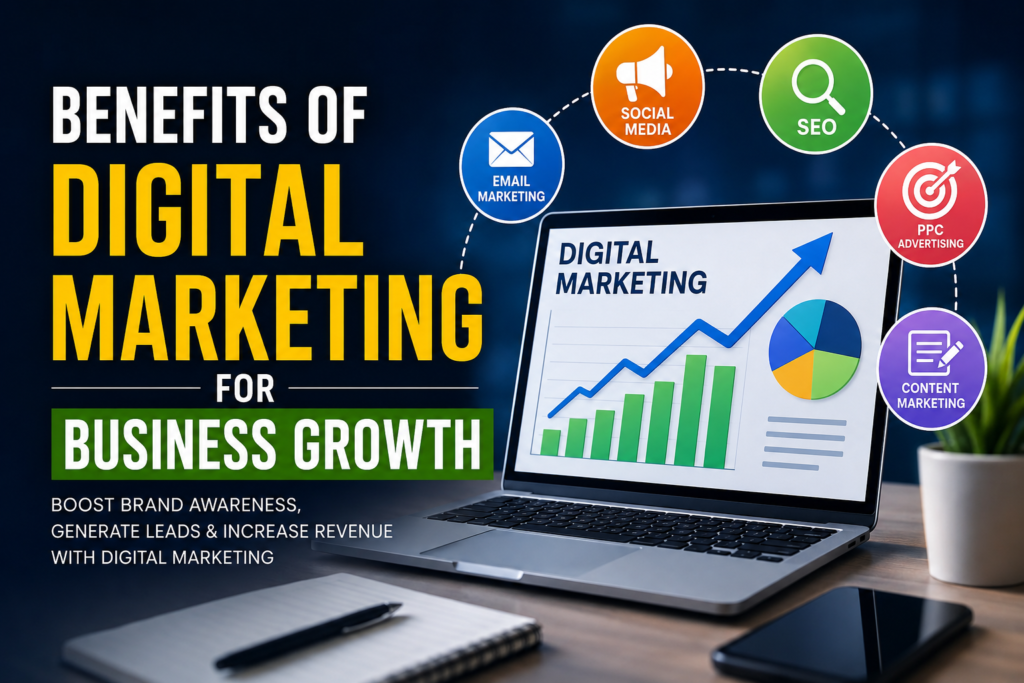
Digital marketing encompasses various online channels, including search engines, social media platforms, email campaigns, content marketing, search engine optimization (SEO), pay-per-click (PPC) advertising, influencer marketing, and more. Each channel plays a unique role in helping businesses attract new customers, nurture relationships, and increase revenue.
In this comprehensive guide, we’ll explore the key benefits of digital marketing for business growth, explain why it has become essential in today’s competitive landscape, and discuss practical strategies that businesses can use to achieve long-term success.
What is Digital Marketing?
Digital marketing is the practice of promoting products, services, or brands using online channels and digital technologies. It involves connecting with potential customers through websites, search engines, social media platforms, mobile applications, email, and online advertisements.
The primary objective of digital marketing is to reach the right audience at the right time with relevant messaging that encourages engagement and drives conversions.
Unlike traditional advertising methods such as newspapers, magazines, radio, or television, digital marketing enables businesses to interact directly with consumers while tracking every stage of the customer journey.
Major Components of Digital Marketing
1. Search Engine Optimization (SEO)
SEO focuses on improving a website’s visibility in search engine results pages (SERPs). A well-optimized website attracts organic traffic without paying for every visitor.
Benefits include:
- Higher Google rankings
- Increased website traffic
- Better brand credibility
- Long-term lead generation
2. Content Marketing
Content marketing involves creating valuable and informative content that educates, entertains, or solves customer problems.
Examples include:
- Blog posts
- Articles
- Videos
- E-books
- Case studies
- Infographics
- Podcasts
High-quality content helps businesses establish authority while attracting potential customers through search engines and social media.
3. Social Media Marketing
Platforms like Facebook, Instagram, LinkedIn, X, Pinterest, and YouTube enable businesses to build communities, engage with audiences, and increase brand awareness.
Social media marketing supports:
- Customer engagement
- Brand storytelling
- Lead generation
- Community building
- Customer support
4. Pay-Per-Click (PPC) Advertising
PPC advertising allows businesses to display paid ads on search engines and social media platforms.
Popular platforms include:
- Google Ads
- Meta Ads
- LinkedIn Ads
- Microsoft Ads
Businesses only pay when users click on their advertisements, making PPC a highly measurable advertising method.
5. Email Marketing
Email remains one of the highest ROI digital marketing channels.
Businesses use email marketing for:
- Promotions
- Newsletters
- Product launches
- Customer retention
- Automated follow-ups
6. Affiliate and Influencer Marketing
Businesses collaborate with influencers and affiliates to promote products to wider audiences while leveraging trust built within niche communities.
Why Digital Marketing is Essential for Business Growth
Consumer behavior has evolved significantly over the last decade.
Today’s customers:
- Search online before making purchases.
- Read reviews before trusting a business.
- Compare prices across multiple websites.
- Follow brands on social media.
- Watch videos before buying products.
- Expect personalized experiences.
If your business isn’t visible online, you’re missing valuable opportunities to connect with potential customers.
Digital marketing helps businesses meet customers where they already spend their time—online.
Top Benefits of Digital Marketing for Business Growth
1. Increases Brand Awareness
Brand awareness is the foundation of business growth.
Customers cannot purchase from businesses they don’t know exist.
Digital marketing helps businesses become visible through:
- Google Search
- Social media platforms
- YouTube videos
- Online advertisements
- Blog content
- Email campaigns
The more frequently potential customers encounter your brand online, the more likely they are to remember and trust it.
Consistent branding across digital channels reinforces recognition and builds familiarity over time.
Example
A local bakery consistently shares recipes, behind-the-scenes videos, customer testimonials, and seasonal promotions on Instagram and Facebook. Over time, local residents begin recognizing the brand, leading to increased foot traffic and online orders.
2. Cost-Effective Marketing
Traditional marketing often requires substantial investments in television commercials, newspaper ads, billboards, or radio campaigns.
Digital marketing offers significantly lower costs while reaching larger audiences.
Businesses can start with modest budgets and scale campaigns based on performance.
Examples include:
- Running Facebook ads for as little as a few hundred rupees per day
- Publishing SEO blogs that continue attracting visitors for months or years
- Sending email campaigns to thousands of subscribers at minimal cost
This affordability makes digital marketing especially valuable for startups and small businesses.
3. Reaches a Highly Targeted Audience
One of the greatest advantages of digital marketing is precise audience targeting.
Instead of showing advertisements to everyone, businesses can target people based on:
- Age
- Gender
- Interests
- Occupation
- Location
- Income level
- Online behavior
- Purchase history
This precision ensures marketing budgets are spent on people most likely to become customers.
Example
A fitness center in Mumbai can display advertisements only to users aged 20–45 living within a 10-kilometer radius who have shown interest in health, fitness, or gym memberships.
Such targeted advertising dramatically improves conversion rates.
4. Generates High-Quality Leads
Lead generation is crucial for sustainable business growth.
Digital marketing helps businesses attract potential customers actively searching for products or services.
Effective lead generation methods include:
- SEO
- Google Ads
- Landing pages
- Lead magnets
- Webinars
- Email campaigns
- Social media advertisements
Unlike cold calling, digital marketing attracts users already interested in what your business offers.
These leads generally have higher conversion potential.
5. Delivers Measurable Results
Traditional advertising often makes it difficult to determine campaign effectiveness.
Digital marketing provides detailed analytics, including:
- Website visitors
- Click-through rates
- Bounce rates
- Conversion rates
- Sales
- Revenue
- Customer acquisition cost
- Return on investment (ROI)
Businesses can continuously optimize campaigns using real-time performance data.
This leads to smarter marketing decisions and better overall results.
6. Builds Customer Trust and Credibility
Modern customers trust businesses that maintain a professional online presence.
Digital marketing helps establish credibility through:
- Positive customer reviews
- Educational blog content
- Expert videos
- Case studies
- Testimonials
- Active social media engagement
When businesses consistently provide valuable information, they position themselves as industry experts.
Trust significantly influences purchasing decisions.
7. Improves Customer Engagement
Unlike traditional marketing, digital marketing creates two-way communication.
Businesses can interact with customers through:
- Comments
- Direct messages
- Live chats
- Emails
- Polls
- Webinars
- Social media discussions
This interaction builds stronger relationships while improving customer satisfaction.
Engaged customers often become loyal advocates who recommend the business to others.
8. Supports Local Business Growth
Digital marketing isn’t only for global brands.
Local businesses benefit tremendously through:
- Google Business Profile optimization
- Local SEO
- Customer reviews
- Google Maps visibility
- Geo-targeted advertisements
A local restaurant, clinic, gym, or salon can attract nearby customers searching for services in their area.
This increases walk-in traffic while strengthening local brand recognition.
9. Creates Long-Term Business Assets
Unlike paid advertisements that stop generating traffic once the budget ends, digital marketing creates lasting assets.
Examples include:
- SEO-optimized blog articles
- Evergreen YouTube videos
- Email subscriber lists
- Social media communities
- High-ranking landing pages
These assets continue attracting customers long after they’re created, providing ongoing value and reducing future marketing costs.
10. Increases Website Traffic
Your website serves as your digital storefront.
Digital marketing drives qualified visitors through:
- Organic search
- Paid advertisements
- Social media
- Referral traffic
- Email campaigns
- Video marketing
Higher-quality traffic increases opportunities for lead generation, sales, and customer acquisition.
11. Higher Conversion Rates
Generating traffic to your website is important, but converting visitors into customers is what truly drives business growth. Digital marketing excels because it not only attracts the right audience but also helps guide them through the buying journey.
Unlike traditional marketing, digital marketing enables businesses to optimize every step of the customer experience. Landing pages, personalized offers, retargeting campaigns, and user-friendly website design all contribute to increasing conversion rates.
Ways Digital Marketing Improves Conversions
- SEO attracts users actively searching for your products or services.
- Google Ads target customers with high purchase intent.
- Social media campaigns build trust and encourage interaction.
- Email marketing nurtures leads until they are ready to buy.
- Retargeting reminds previous visitors to return and complete their purchase.
Example
Imagine a user searching for “best digital marketing agency near me.” If your website appears on the first page of Google with strong reviews, a professional design, and a clear call-to-action, the chances of converting that visitor into a customer are significantly higher.
12. Better Return on Investment (ROI)
Every business wants to maximize the value of its marketing budget. One of the greatest advantages of digital marketing is its ability to deliver measurable and often higher returns compared to traditional advertising.
With digital marketing, every campaign can be tracked, analyzed, and optimized. Businesses can identify which channels generate the most leads, sales, and revenue, allowing them to allocate budgets more effectively.
Why ROI is Higher
- Highly targeted audience selection
- Lower advertising costs
- Real-time optimization
- Performance tracking
- Reduced waste in marketing spend
For example, if a Google Ads campaign generates ₹2,00,000 in sales while costing only ₹25,000, the business can clearly measure its profitability and scale the campaign accordingly.
13. Data-Driven Decision Making
Successful businesses rely on data rather than assumptions.
Digital marketing platforms provide detailed insights into customer behavior, helping businesses understand:
- Where visitors come from
- Which pages they visit
- How long they stay
- Which products they view
- What encourages them to make a purchase
- Where they leave the sales process
This information allows marketers to continuously improve campaigns and customer experiences.
Important Metrics to Track
- Website Traffic
- Organic Search Visitors
- Conversion Rate
- Cost Per Click (CPC)
- Cost Per Acquisition (CPA)
- Return on Ad Spend (ROAS)
- Customer Lifetime Value (CLV)
- Bounce Rate
- Click-Through Rate (CTR)
Businesses that regularly analyze these metrics can make smarter marketing decisions and achieve sustainable growth.
14. Personalized Customer Experiences
Modern consumers expect brands to understand their needs and provide relevant recommendations.
Digital marketing enables businesses to personalize communication based on customer behavior, preferences, and purchase history.
Personalization Examples
- Product recommendations based on previous purchases
- Personalized email campaigns
- Dynamic website content
- Location-based offers
- Birthday discounts
- Cart abandonment reminders
Personalized marketing improves customer satisfaction while increasing sales and customer loyalty.
15. Marketing Automation Saves Time
Managing multiple marketing activities manually can become overwhelming, especially as a business grows.
Marketing automation allows businesses to automate repetitive tasks, improving efficiency and reducing operational costs.
Tasks That Can Be Automated
- Email campaigns
- Lead nurturing
- Social media scheduling
- Customer follow-ups
- SMS campaigns
- Welcome emails
- CRM updates
- Appointment reminders
Automation ensures consistent communication without requiring constant manual effort.
16. Improves Customer Retention
Acquiring new customers is important, but retaining existing customers is often more profitable.
Digital marketing helps businesses maintain strong relationships through continuous engagement.
Customer Retention Strategies
- Email newsletters
- Loyalty programs
- Exclusive offers
- Personalized recommendations
- Customer appreciation campaigns
- Educational content
- Regular social media interaction
Satisfied customers are more likely to make repeat purchases and recommend your business to others.
17. Gives Small Businesses a Competitive Advantage
One of the most significant benefits of digital marketing is that it levels the playing field.
In traditional advertising, large corporations often dominate due to massive budgets. However, digital marketing allows small businesses to compete by focusing on niche audiences, local SEO, and high-quality content.
Example
A local bakery with a strong Google Business Profile, active Instagram page, and optimized website can outperform larger competitors in local search results by consistently engaging with its community and earning positive reviews.
This demonstrates that strategic digital marketing can help smaller businesses achieve remarkable visibility and growth.
18. Supports Mobile Marketing
Today, a significant portion of internet users browse websites, shop online, and interact with brands using smartphones.
Businesses must ensure their digital marketing strategies are mobile-friendly.
Mobile Marketing Includes
- Responsive websites
- Mobile-friendly emails
- SMS marketing
- Mobile apps
- Location-based advertising
- Click-to-call advertisements
A seamless mobile experience improves user satisfaction and increases conversion opportunities.
19. Expands Global Reach
Traditional marketing often limits businesses to local or regional audiences.
Digital marketing enables businesses to reach customers worldwide.
Even small businesses can sell products or services internationally through:
- E-commerce websites
- International SEO
- Social media platforms
- Google Ads
- Online marketplaces
This global accessibility creates new revenue opportunities and supports business expansion.
20. Enhances Brand Authority
Consumers prefer purchasing from brands they trust.
Digital marketing helps businesses establish authority by consistently publishing valuable, educational content.
Content That Builds Authority
- Industry blogs
- Case studies
- White papers
- Expert interviews
- Tutorials
- Webinars
- Podcasts
When businesses demonstrate expertise, they become trusted sources of information, increasing customer confidence and purchase likelihood.
21. AI is Transforming Digital Marketing
Artificial Intelligence (AI) is revolutionizing how businesses market their products and services.
AI-powered tools help marketers:
- Generate content
- Analyze customer behavior
- Optimize advertising campaigns
- Predict purchasing trends
- Improve customer support through chatbots
- Personalize user experiences
AI allows businesses to work more efficiently while delivering better customer experiences.
22. Omnichannel Marketing Creates Better Customer Experiences
Today’s customers interact with businesses across multiple platforms.
A potential customer may:
- Discover your business on Instagram.
- Visit your website.
- Read your blog.
- Subscribe to your email newsletter.
- Watch your YouTube videos.
- Search your business on Google.
- Finally make a purchase.
Omnichannel marketing ensures a consistent brand experience across every customer touchpoint.
This consistency builds trust and improves conversion rates.
23. Faster Customer Feedback
Customer feedback is essential for business improvement.
Digital marketing allows businesses to receive immediate feedback through:
- Online reviews
- Social media comments
- Surveys
- Polls
- Website forms
- Live chat
- Customer support interactions
Quick feedback helps businesses identify strengths, address weaknesses, and improve products or services more effectively.
24. Builds Long-Term Customer Relationships
Successful businesses focus on relationships rather than one-time sales.
Digital marketing encourages ongoing engagement by providing value before asking customers to buy.
Businesses can educate customers through:
- Blog articles
- Video tutorials
- Email newsletters
- Social media posts
- Free resources
- Online communities
When customers consistently receive valuable information, they are more likely to remain loyal to the brand.
25. Encourages Innovation and Continuous Improvement
The digital landscape evolves rapidly. New platforms, technologies, and consumer behaviors emerge regularly.
Businesses using digital marketing can quickly test new ideas, measure performance, and adapt their strategies.
Examples include:
- A/B testing landing pages
- Experimenting with new ad creatives
- Trying different content formats
- Launching new campaigns based on audience insights
This culture of experimentation helps businesses stay ahead of competitors and respond effectively to changing market conditions.
Real-World Success Example
Consider a small clothing boutique that primarily relied on walk-in customers. By implementing a digital marketing strategy, the business:
- Created a professional e-commerce website.
- Optimized product pages for SEO.
- Shared styling tips and product showcases on Instagram.
- Ran targeted Meta Ads for seasonal collections.
- Sent email newsletters with exclusive offers.
- Encouraged satisfied customers to leave Google reviews.
Within a year, the boutique experienced:
- Increased website traffic
- Higher online sales
- Improved brand recognition
- More repeat customers
- Expansion beyond its local market
This example highlights how combining multiple digital marketing channels can produce sustainable business growth.
Common Digital Marketing Mistakes Businesses Should Avoid
While digital marketing offers tremendous opportunities, many businesses fail to achieve the desired results because they overlook fundamental strategies. Understanding these common mistakes can help you create campaigns that deliver consistent growth.
1. Not Having a Clear Strategy
Many businesses jump into digital marketing without setting specific goals. Posting randomly on social media or running advertisements without a plan often leads to wasted time and money.
Instead, define clear objectives such as:
- Increase website traffic by 30%
- Generate 100 qualified leads per month
- Improve Google rankings for target keywords
- Boost online sales by 20%
- Increase customer retention
Having measurable goals makes it easier to evaluate success and optimize campaigns.
2. Ignoring Search Engine Optimization (SEO)
Some businesses rely only on paid advertising while neglecting SEO.
Although paid ads can generate immediate traffic, SEO provides long-term visibility and sustainable growth. A well-optimized website can continue attracting visitors for years without paying for every click.
An effective SEO strategy should include:
- Keyword research
- On-page optimization
- Technical SEO
- High-quality content
- Internal linking
- Mobile optimization
- Page speed improvements
- Link building
3. Publishing Low-Quality Content
Content remains one of the strongest pillars of digital marketing.
Publishing articles that offer little value or simply repeat information found elsewhere will not help your business stand out.
Instead, focus on creating content that:
- Solves customer problems
- Answers common questions
- Provides actionable advice
- Shares industry insights
- Includes real examples and case studies
High-quality content builds trust, improves SEO rankings, and encourages visitors to spend more time on your website.
4. Neglecting Mobile Users
With most internet users browsing on smartphones, businesses must ensure their websites and campaigns are optimized for mobile devices.
A mobile-friendly website should feature:
- Responsive design
- Fast loading speed
- Easy navigation
- Readable text
- Clickable buttons
- Secure browsing experience
Poor mobile experiences often lead to higher bounce rates and lost sales.
5. Failing to Analyze Performance
Digital marketing provides valuable data, but many businesses fail to use it effectively.
Regularly reviewing analytics helps identify what is working and what needs improvement.
Monitor key performance indicators such as:
- Organic traffic
- Conversion rate
- Bounce rate
- Click-through rate
- Cost per acquisition
- Return on investment
- Customer lifetime value
Data-driven decisions lead to better marketing outcomes.
How to Create an Effective Digital Marketing Strategy
A successful digital marketing strategy requires careful planning and continuous improvement.
Step 1: Define Your Target Audience
Understand your ideal customer by identifying:
- Age
- Gender
- Location
- Occupation
- Income level
- Interests
- Online behavior
- Pain points
The more you understand your audience, the more relevant your marketing becomes.
Step 2: Build a Professional Website
Your website serves as the foundation of your digital presence.
Ensure it is:
- Fast
- Secure (HTTPS)
- Mobile responsive
- SEO-friendly
- Easy to navigate
- Optimized for conversions
A professional website builds trust and encourages visitors to take action.
Step 3: Invest in SEO
SEO helps your business appear in search engine results when potential customers are actively searching for your products or services.
Focus on:
- High-quality content
- Keyword optimization
- Local SEO
- Technical SEO
- Quality backlinks
SEO is a long-term investment that continues generating organic traffic over time.
Step 4: Create Valuable Content
Develop a content strategy that includes:
- Blog articles
- Videos
- Infographics
- Case studies
- E-books
- FAQs
- Tutorials
Consistently publishing valuable content positions your business as an industry expert.
Step 5: Use Social Media Strategically
Choose platforms where your audience is most active.
Examples:
- Instagram for visual brands
- LinkedIn for B2B businesses
- Facebook for local communities
- YouTube for educational content
- X (formerly Twitter) for industry updates
Focus on quality engagement rather than simply increasing follower counts.
Step 6: Leverage Paid Advertising
Paid advertising accelerates growth by reaching targeted audiences quickly.
Popular advertising platforms include:
- Google Ads
- Meta Ads
- LinkedIn Ads
- YouTube Ads
Regularly test different creatives, headlines, and audience segments to improve campaign performance.
Step 7: Measure and Improve
Digital marketing is an ongoing process.
Continuously evaluate performance and optimize based on data to achieve better results over time.
Future Trends in Digital Marketing
The digital marketing landscape continues to evolve rapidly. Businesses that adapt to emerging trends will gain a competitive advantage.
Artificial Intelligence (AI)
AI-powered tools are transforming:
- Content creation
- Customer service
- Predictive analytics
- Marketing automation
- Personalization
Businesses that embrace AI can improve efficiency while delivering better customer experiences.
Voice Search Optimization
With the growing popularity of voice assistants, optimizing content for conversational search queries is becoming increasingly important.
Businesses should target natural language keywords and frequently asked questions.
Video Marketing
Short-form videos continue to dominate online engagement.
Platforms such as YouTube Shorts, Instagram Reels, and Facebook Reels offer businesses powerful opportunities to educate, entertain, and convert audiences.
Personalization
Customers increasingly expect personalized experiences.
Businesses that provide tailored recommendations, customized emails, and relevant offers will strengthen customer loyalty.
Privacy and First-Party Data
As privacy regulations evolve, businesses should focus on collecting first-party data ethically through email subscriptions, customer accounts, and loyalty programs.
Transparency builds trust and strengthens customer relationships.
Actionable Tips for Business Owners
To maximize the benefits of digital marketing:
- Develop a long-term marketing strategy.
- Invest in SEO for sustainable growth.
- Publish valuable content consistently.
- Build a strong presence on relevant social media platforms.
- Optimize your website for mobile users.
- Collect and respond to customer reviews.
- Use analytics to guide decisions.
- Test and optimize campaigns regularly.
- Invest in email marketing for customer retention.
- Stay updated with new technologies and industry trends.
Conclusion
Digital marketing has become one of the most effective ways to grow a business in today’s competitive marketplace. It enables businesses to reach targeted audiences, build strong customer relationships, generate qualified leads, increase brand awareness, and achieve measurable results.
Unlike traditional marketing, digital marketing offers flexibility, scalability, and precise performance tracking. Whether you are a startup, a local business, or an established enterprise, a well-planned digital marketing strategy can help you attract more customers, improve conversions, and create long-term business success.
Success does not come from using a single marketing channel. Instead, it comes from integrating SEO, content marketing, social media, paid advertising, email marketing, and analytics into a cohesive strategy that continuously evolves with customer needs and market trends.
Businesses that invest in digital marketing today are better positioned to compete, innovate, and grow in the years ahead.
Frequently Asked Questions (FAQs)
1. What is digital marketing?
Digital marketing is the promotion of products or services using online channels such as search engines, social media, email, websites, and paid advertising.
2. Why is digital marketing important for business growth?
It helps businesses increase brand visibility, generate qualified leads, improve customer engagement, and achieve measurable growth while maximizing return on investment.
3. Which digital marketing strategy delivers the best long-term results?
Search Engine Optimization (SEO), combined with high-quality content marketing, often delivers sustainable long-term growth by generating consistent organic traffic.
4. Can small businesses benefit from digital marketing?
Yes. Digital marketing provides affordable and highly targeted marketing opportunities, allowing small businesses to compete effectively with larger brands.
5. How long does digital marketing take to show results?
Paid advertising can generate immediate traffic, while SEO and content marketing typically produce significant results within three to six months, depending on competition and consistency.
SEO Elements
SEO Title
Benefits of Digital Marketing for Business Growth: 25 Proven Ways to Grow Your Business Online
Meta Title (60 Characters)
Benefits of Digital Marketing for Business Growth
Meta Description (155 Characters)
Discover the top benefits of digital marketing for business growth. Learn how SEO, social media, content marketing, and paid ads help increase leads and sales.
URL Slug
benefits-of-digital-marketing-for-business-growth
Suggested Internal Links
- Digital Marketing Services
- Search Engine Optimization (SEO)
- Google Ads Management
- Social Media Marketing
- Content Marketing Guide
- Local SEO Services
- Website Development Services
- Email Marketing Strategy
Suggested External Links
- Google Search Central
- Google Analytics
- Google Ads
- Meta Business
- HubSpot Marketing Resources
Final Thoughts
Digital marketing is no longer optional—it is a core driver of modern business success. Companies that focus on delivering value, understanding customer needs, and continually refining their digital strategies are far more likely to achieve sustainable growth.
Whether your goal is to increase website traffic, generate more leads, improve customer loyalty, or expand into new markets, digital marketing provides the tools and insights needed to make those goals a reality. By staying consistent, embracing innovation, and measuring results, your business can build a strong online presence and thrive in an increasingly digital world.